
Choosing Shore 10A vs 30A for Complex Silicone Parts
Shore 10A stretches over deep undercuts; Shore 30A holds a seal or pour face. Spec hardness with tear, then pick an HCR or LSR tool-not a mid-Shore compromise.
On this page
If you're specifying Shore 10A versus 30A on a complex silicone SKU, hardness is a demold and cavity-hold decision, not a quality ranking.
Choose 10A when the molded part has to stretch over a lock: deep undercuts, negative draft, or interlocking detail. Choose 30A when the pull is mostly open and the rubber has to hold a seal, a wall, or a pour face under load. If you need both stretch and stiffness, don't split the difference at 20A. Prototype a thin 10A skin as an RTV prototype mold, then decide whether production is HCR compression or LSR injection-and whether a jacket or a split belongs on the steel.
That's the call most failed first articles get wrong. Shore A is an indentation test. It does not measure tear, elongation, or whether the grade will survive a resin pour if the SKU is itself a tray.

Shore A is not a quality ranking
Buyers treat 10A and 30A as “soft quality” versus “production quality,” then paste an RTV glove-mold Shore onto an LSR gasket RFQ. The mill, the press, and the spare-parts list are not the same. A 10A platinum RTV skin is a prototype or a flexible cavity. A 30A HCR compression part is a millable article with a flash land. Copying the durometer across those families is how a quote quietly drops tear, shrink, and the tool.
What a 90 × 55 mm sleeve quote is actually buying
Say you need a 90 × 55 mm silicone sleeve with a 4 mm undercut lip, 40A mating housing, 200 first articles and about 4,000 a year.
For the 200, a lot of programs start on an aluminum one-cavity, or on an RTV jacket if you're still proving the lip stretch.
For a few thousand millable covers, the shop will usually cut a heated two-plate HCR tool: cavity, flash land, locators, heat from the platens or cartridges. Soft 10A HCR is awkward to mill and to deflash; many shops will push you toward 20-30A or toward LSR for that lip.
If annual volume and an LSR grade are already on the PO, the production tool needs cavity heat, gates, vents, and usually a cold-runner. Those three PDFs can all say “Shore 10A mold.” You're not buying the same manufacturing asset.
Checks before you compare two Shore quotes

Before you compare prices, get answers on:
- Is this Shore the part hardness, or the RTV prototype mold hardness?
- HCR compression, LSR injection (cold-runner or dump-runner), or RTV master-and-jacket only for validation?
- Tear (ASTM D624, die stated) and elongation (ASTM D412) at that Shore-not durometer alone?
- Who owns the plates and inserts after the tooling charge, and can you move the tool?
- ISO 3302-1 class on the drawing (M2 is a common default)-and which dimensions are actually critical after stretch?
If those five lines are missing, the cheaper quote is usually the incomplete one.
What Shore A actually measures (and what it does not)
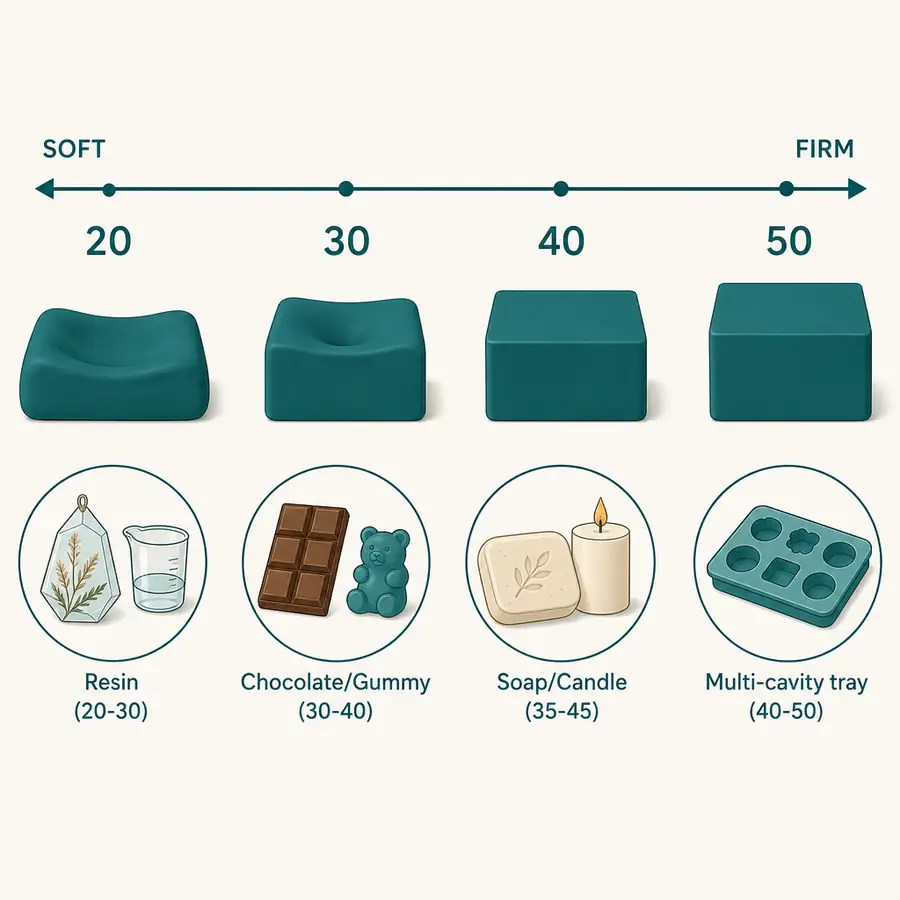
Shore A is an indentation test. A durometer pin presses the cured rubber. A low number means the rubber gives. A high number means it resists.
On the press that maps to two behaviors you feel on every pull:
- 10A stretches around a trapped feature, then rebounds.
- 30A keeps walls upright, so a seal bead, a tray floor, or a pour face doesn't sag, balloon, or oval.
Shore A does not measure tear strength, elongation, viscosity, or chemical resistance. Two 10A silicones can feel similar on a datasheet and fail in completely different ways: one inverts a sleeve a hundred times, the other splits on the first undercut. Buy hardness and tear as a pair.
A step past the usual SERP: Shore A is also not perceived stiffness in use. A thin 30A lip can feel softer in the hand than a thick 10A block. Wall and geometry override the pin.
Platinum LSR and platinum HCR are the usual production chemistries. Peroxide HCR is common on industrial 30A-and-up parts after a ventilated post-cure. Tin-cure RTV is a prototype bypass when a printed master poisons platinum-not a production compound for a 4,000-piece sleeve.
10A when the pull is the hard part
10A is the right call when demolding stress is bending and stretching, not structure.
Use it for:
- Sleeves, bellows, and organic covers with recessed faces or crossed features
- Filigree or lattice that would snap if the rubber would not flex
- One-piece parts you plan to roll off a core
- Masters you cannot draft, because the design is the undercut
A rigid mating part cannot collapse to escape. The silicone has to. 10A can elongate over a bulge, slide past it, and recover. 30A fights that motion. The fight shows up as torn lips, white stress marks, or a snapped resin finger if the SKU is a casting tray.
The cost of 10A is shape. Left unsupported, a 10A tray slumps. Thin walls oval. A deep pour of epoxy or polyurethane pushes the cavity out, and you get a fat casting with rounded corners. That is 10A used like 30A.
If you pick 10A for a complex resin-facing tray, budget a rigid jacket or a steel backup in the same job. The soft rubber does the stretch. The shell does the geometry. Thick epoxy and fast polyurethane also throw an exotherm; soft rubber can locally soften and print that heat as a dimensional error.
30A when the cavity or the seal is the hard part
30A is the right call when the part can leave the tool without a wrestling match, and the rubber itself has to behave like a tool or a seal.
Use it for:
- Open-back trays, coasters, cabochons, and low-relief panels
- Gaskets and covers whose pull is drafted but the bead must stay round
- Deeper epoxy-facing cavities where wall bulge would ruin thickness or fit
- Production parts loaded, closed, and packed the same way every cycle
30A still flexes. What it will not do, reliably, is invert around a locked feature. If the operator has to “work the part out” with both thumbs, you chose too hard-or you needed a split, a core, or a side action in the steel.
The win is dimensional control. Walls stand. Corners stay corners. A 30A HCR part is also easier to handle: it doesn't fold in on itself, and it seats in a fixture without a custom shell.
If your “complex” SKU is complex in texture but simple in release, 30A will usually beat 10A on reject rate.
The option that ranks: 10A skin plus a stiff backup
Search results treat 10A and 30A as rivals. For the hardest resin-facing parts, they are a system.
The production pattern for a locked, high-detail tray:
- 1. Validate a thin 10A skin on an RTV prototype mold (the layer that copies detail and stretches on release).
- 2. Back it with a rigid jacket-or, in steel, a 30A-class HCR/LSR body with a soft insert if the volume justifies two durometers.
- 3. Key the shell so it always closes in the same place.
- 4. On every cycle: open the shell, stretch the 10A off the casting, reset, pour again.
You get 10A's undercut performance and 30A's cavity control. You do not get a compromise hardness that is slightly too stiff to release and slightly too soft to hold size.
For OEM parts that are not trays (a sleeve that ships as the SKU), the analog is: split or core the steel so the 30A grade can run, rather than forcing a 10A compression job that the mill hates.
Resin type can veto a 10A-only tool
Geometry is first. The resin-if the SKU is a casting cavity-is second.
Epoxy. Moderate exotherm, longer gel. 10A plus a shell is the standard for undercut pieces. 30A is cleaner for open molds and anything thicker than a few millimetres where wall bulge would show.
UV resin. Low mass, little heat, high demand for a flat, sharp cavity. 30A (or 20-25A) usually wins. 10A UV trays go wavy unless they sit in a rigid frame the entire cure.
Polyurethane. Fast, hot, abrasive to the face. Soft 10A can distort in the heat spike and wear sooner. Prefer 30A on open tools. Keep 10A only when the undercut leaves you no choice, and always jacket it.
Release agent is rarely required between platinum silicone and epoxy or PU, but a light release can reduce abrasion on a production 30A tool. Never use that as a substitute for the right hardness.
Hardness is not toughness
A cheap 10A that tears is worse than a well-formulated 20A. Before you lock a hardness, check four other lines:
- Tear strength (ASTM D624, die stated). Undercut work lives or dies here.
- Elongation (ASTM D412). Glove-style inversion needs the high end of the band.
- Viscosity / mill behavior. LSR fills thin lips. Soft HCR on a mill is a different handling problem.
- Shrink and class. Typical HCR shrink is about 1.5-2.5%; LSR about 2-3%. ISO 3302-1 M2 is a common drawing default, not a slogan for “precision.”
If two products both say 10A and only one lists high tear and high elongation, they are not interchangeable.
When this article is the wrong quote
If you need a reusable RTV cavity (gummy, chocolate, resin, soap) rather than a vulcanized silicone part, stop here and quote a master + box + jacket job on the WYD quote form instead. A cheap aluminum one-cavity can also beat both a full LSR cold-runner and a large multi-core RTV stack when the geometry is tiny and the annual quantity is only a few hundred. Geometry and what actually ships override the Shore number on the RFQ.
Related reading: silicone mold tooling explained, Shore A for deep-undercut parts, LSR vs HCR prototype tooling, design-for-manufacture (DFM) for silicone parts.
What to send for a Shore quote
Copy this into the RFQ. Incomplete lines are why two “10A vs 30A” numbers cannot be compared.
- STEP/STL and 2D with the worst undercut dimensioned, plus a rubber tolerance class (often ISO 3302-1 M2)
- What ships: molded silicone part, or a flexible cavity other people will pour into
- Target Shore A, tear/elongation if you have them, polymer family (HCR / LSR), post-cure or food-contact path
- First quantity and annual quantity
- Process preference: HCR compression vs LSR injection (cold-runner vs dump-runner); RTV prototype mold only if you say so
- Who should own plates/inserts after the tooling charge, and whether the tool may be moved
- Current failure, if this is a transfer: tear at the lip, ballooned cavity, snapped casting
Send the STEP file, the undercut, annual quantity, and HCR vs LSR preference. That is enough for a plate-stack sketch before anyone mills steel.
Path after the Shore call: prototype mold, HCR, or LSR
Do not pour a mid-Shore “compromise” grade, or cutting a steel LSR tool with a cold-runner, before a 90 × 55 mm sleeve has run as a one-cavity HCR or aluminum prototype mold-unless annual volume and automation are already on the PO. Do not raise Shore A to “hold size” when the lip still needs 10A stretch. Jacket or split first. Do not treat a tooling charge as ownership; if the agreement is silent, you have not bought unrestricted transfer.
WYD Prototype → Compression → LSR (use this on the RFQ, then ignore quantity if geometry disagrees):
Route the RFQ from what actually ships: if Reusable RTV cavity for resin, go to an RTV master-and-jacket quote on the WYD quote form; if Molded silicone part or production tray, go to Undercut vs cavity-hold; if Must stretch over a lock / 10A class, go to Aluminum or RTV prototype mold, then split or jacket; if Thousands, millable HCR, open pull / 30A, go to HCR compression: mill, preform, flash land, deflash; if Higher annual, LSR grade, thin lip, automation, go to LSR injection: cavity heat, gates, vents, cold-runner.
Geometry and what actually ships override the process name. A tiny 10A sleeve at 400 pcs/year is still a compression or prototype mold job. A deep undercut at 50,000 pcs still needs side actions no matter which rubber family you pick.
RFQ comparison bands: 90 × 55 mm sleeve with a 4 mm lip
| Route | Typical first qty | Hardware | Typical shrink allowance | Typical drawing class |
|---|---|---|---|---|
| RTV prototype mold / jacket | 20-50 | Master + box + jacket | Platinum RTV ~0.1-0.3% | Cavity, not a rubber-article class |
| HCR compression | Low thousands | Two-plate, flash land, platen or cartridge heat | ~1.5-2.5% | ISO 3302-1 M2 unless the 2D says M1/M3 |
| LSR + cold-runner | High annual, automation | Steel, cavity heat, gates/vents, cold-runner | ~2-3% (grade/temp) | Same drawing class + first-article inspection (FAI) remeasure |
These are shop-normal bands for RFQ comparison, not a named lot. Geometry and what ships still override the table.
FAQ
Should I spec Shore 10A for a sleeve with a 4 mm undercut lip and a hollow face? Yes if those features are true undercuts with no straight pull path. The mating housing cannot collapse, so the rubber has to elongate over the lock and recover. Budget a prototype mold and a jacket or a split in the same job; unsupported 10A will slump or balloon and you will get a fat part with rounded corners.
Does a 10A skin inside a 30A jacket beat pouring Shore 20A as a compromise? For locked, high-detail trays, yes. The soft skin copies detail and stretches on release; the jacket holds the cavity. A mid hardness is slightly too stiff to invert and slightly too soft to hold size, which is how shops fight a tool for a month.
Why does a shallow UV-resin tray go wavy in 10A even though the pull is open? UV resin is low mass and little heat, but it demands a flat, sharp pour face. 10A trays go wavy unless they sit in a rigid frame the entire cure. 30A, or 20-25A, is the usual win for that geometry-and production of that tray is usually HCR or LSR, not a library RTV block.
Will a higher Shore last longer into hot polyurethane? Not automatically. Fast PU is abrasive and spikes heat; a soft 10A can distort in the exotherm and wear sooner, so 30A is preferred on open tools. A supported high-tear 10A can still outlast a cheap 30A that you have to force over an undercut. Abrasion, tear, and how you demold beat a durometer ranking.
Can I fix sticky platinum on an SLA master by switching from 10A to 30A? No. That is cure inhibition from leftover acrylate, not hardness. Fully post-cure the print, wash it, and barrier-coat if needed. Changing Shore will not rescue an uncured resin master, and it will not rescue a production LSR lot poured against a poisoned insert.
Ready to order custom silicone molds?
Send your drawing, sample or project requirements for DFM and quotation.