
Shore A Selection for Deep-Undercut Silicone Parts
Deep undercuts need stretch and tear, not a mid Shore. Soft prototype mold plus a split in steel beats a compromise durometer that tears or traps the part.
On this page
If you cannot draw a straight pull path, hardness is doing the work of a parting line.
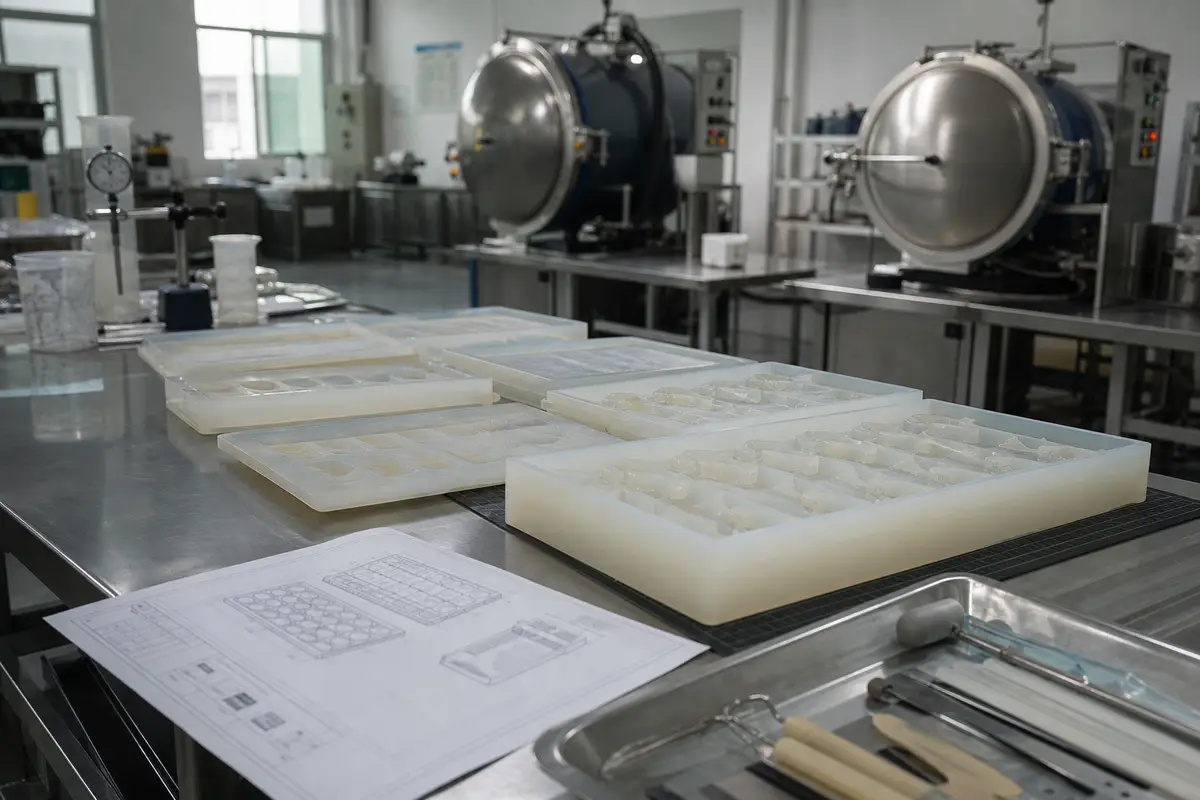
Deep undercuts are a strain budget. The mating part cannot collapse. The silicone must elongate over the lock, then recover, without a nick running. Shore A tells you how easily the pin indents. It does not tell you whether the part will zipper at the undercut. Pick durometer for the stretch. Buy tear (ASTM D624, die stated) for the survival. If those two fight, don't pick 20A as a peace treaty. Split the steel, add a core, or prototype a soft skin as an RTV prototype mold inside a jacket.
LSR and HCR durometers describe parts. RTV durometers describe peelable prototype molds. Don't copy an LSR 50A part spec onto a glove prototype mold, and don't copy a 10A RTV skin onto a compression gasket without checking mill behavior.
20A is not a peace treaty

Buyers treat Shore as a quality ranking, then freeze 20A because stretch and cavity-hold both showed up in the meeting. A mid hardness is slightly too stiff to invert and slightly too soft to hold a cylinder. Paying a tooling charge on a cover photo does not tell you whether the steel has a split, a core, or a prayer.
A 70 × 40 mm barb lock is a strain budget, not a Shore slogan
Say you need a 70 × 40 mm silicone bellows with a 5 mm barb lock, Shore 30A requested, 100 validation pieces and about 5,000 a year.
For the 100, a shop may pour a 10A platinum RTV prototype mold to prove the barb will stretch-or cut an aluminum one-cavity if the CAD already has a split.
For a few thousand millable bellows, you'll usually cut a heated two-plate HCR tool. If the barb stays, you need a split, a loose core, or a grade that can actually elongate. Soft 10A HCR is awkward to mill and deflash.
If annual volume justifies LSR, the production tool needs cavity heat, gates, vents, and usually a cold-runner, plus side actions if the lock will not survive elongation. Don't call that a “LIM hot tool.” Those three PDFs can all say “Shore 30A mold.” You're not buying the same manufacturing asset.
Checks before you freeze a durometer
Before you compare prices, get answers on:
- Is this Shore the part hardness, or the RTV prototype mold hardness?
- HCR compression vs LSR injection (cold-runner vs dump-runner), and will the steel split or core the lock?
- Tear (ASTM D624, die stated) and elongation (ASTM D412) at that Shore?
- Who owns the plates, cores, and inserts after the tooling charge, and can you move the tool?
- ISO 3302-1 class on the drawing (M2 is a common default)-which dimensions are critical after stretch?
If those lines are missing, the cheaper quote is usually the incomplete one.
Locked geometry is a strain budget
An undercut is any feature wider than the path out. Depth, sharpness, and how much circumference is locked matter more than the adjective “deep.”
A rounded 3 mm lip on a 30 mm bottle-shaped part is a modest strain. A 3 mm square hook on a 5 mm stem is a high strain concentration. Letters with negative draft are many tiny undercuts. A lattice is a field of them.
Estimate the stretch the rubber must take: the extra path length over the bulge, divided by the unstretched wall. Soft grades (roughly Shore 00 extra-soft through 10-15A) can take glove-style inversions. Mid 20-30A can take light locks on small parts. 40A and up start to behave like a stiff shoe. You will tear the part or break the core.
Geometry vetoes:
- No draft and a long draw: split, even in 10A.
- Fragile mating part (thin resin fingers, a live barb on a plastic housing): the silicone must be the thing that yields. Stay soft, or add a side action.
- Heavy section that must hold a cylinder: soft walls balloon. Jacket the prototype mold. Don't “fix” ballooning by jumping to 40A if the undercut still needs 10A.
A step past the usual SERP: Shore A is not perceived stiffness in use. A thin 40A lip can feel softer in the hand than a thick 10A block. Wall and geometry override the pin.
Soft enough to peel, high-tear enough not to zipper
Durometer and tear are independent purchases.
A cheap 10A with low tear is a prototype skin. It will invert once and split at the first sharp inside corner. A high-tear 10A is why glove prototype molds exist. A 30A with excellent tear still may not elongate enough to clear a hook. You will not feel that on a datasheet Shore line. You will feel it when the part wedges in the steel.
Read, together:
- Shore A (ASTM D2240)
- Tear (ASTM D624; Die B and Die C are not interchangeable)
- Elongation at break (ASTM D412). Glove inversion wants the high end of the elongation band.
- Process family. LSR fills thin lips. Soft HCR on a mill is a different handling problem.
Platinum RTV is the default for size-holding undercut prototype molds (~0.1-0.3% shrink class). Tin-cure is the default when the master is a platinum poison. Tin will still need the same strain budget. Chemistry does not replace elongation. Production HCR shrink is typically ~1.5-2.5%; LSR ~2-3%. ISO 3302-1 M2 is a common drawing default, not a slogan for “precision.”
Adding a split versus dropping durometer
Three structural answers, not one hardness.
One-piece part, very soft. Roll or invert off a core. Best copy of an organic geometry with no parting line. Needs high tear and high elongation. Labor per cycle is high. Soft HCR at 10A is not the same mill job as 50A.
Two-or-more-piece steel, firmer. A split line through the lock turns an undercut into a straight pull. You can step into 20-40A, hold the cavity, and stop stretching rubber around a hook. You pay a flash line on the part. On mechanical parts that is often the right cost.
Core or loose insert. A trapped internal feature gets its own piece of steel or a rigid core that pulls sideways. Durometer on the main cavity can then be chosen for the seal, not the lock.
If the designer refuses a parting line and refuses a core, they have chosen high-tear soft rubber and a slower cycle. Write that down. Don't discover it at tryout.
Glove skins inside a rigid jacket (prototype mold path)
The prototype pattern for locked, high-detail parts:
- 1. Brush or pour a thin soft skin (often 10A class, high tear) against the master.
- 2. Key it.
- 3. Back it with plaster, a resin shell, a 3D-printed jacket, or a poured firmer rubber.
- 4. Each cycle: open the jacket, peel the skin, reset.
The skin takes the strain. The jacket takes the hydrostatic load and the heat. A 20A block trying to do both jobs is how shops get a prototype mold that is slightly too stiff to invert and slightly too soft to hold a cylinder.
Match skin thickness to the smallest lock. Too thick, and even 10A will not elongate over a deep hook. Too thin, and you tear or print jacket seams.
When you cut production steel, that jacket lesson becomes: split, core, or side action. Don't ask a 30A LSR tool with no side action to do a 10A glove's job.
Freeze hardness only after a pull test on the worst undercut
Don't freeze Shore from a photo of the part.
Mold a short coupon that includes the actual lock, the actual sharp inside corner, and the actual wall you will run. Use the candidate grade. Pull.
Pass: the part survives, the rubber shows no nick at the lock, the cavity resets.
Fail modes:
- Part or mating hardware breaks: too hard, or needs a split.
- Rubber nicks at the corner: tear too low, or strain too high. Softer high-tear, or a split, or a radius on the CAD.
- Cavity oval or fat: too soft for an unsupported pour. Keep the soft skin, add the jacket. Don't jump 20 points of Shore.
- Sticky face on a 3D-printed master: inhibition. Stop. Hardness will not cure a poisoned platinum face.
When this article is the wrong quote
If you need a reusable RTV cavity (gummy, chocolate, resin) rather than a vulcanized silicone part, the Shore call is still stretch versus hold-but the quote is a master + box + jacket job, not HCR/LSR steel. A cheap aluminum one-cavity can beat both a full LSR cold-runner and a large multi-core RTV stack when the bellows is tiny and annual quantity is only a few hundred. Geometry and what actually ships override the Shore number on the RFQ.
Related reading: Shore 10A vs 30A for complex parts, silicone mold tooling explained, tensile and tear specs, design-for-manufacture (DFM) for silicone parts.
What to send for an undercut quote
Copy this into the RFQ.
- STEP/STL and 2D with the worst undercut dimensioned, plus a rubber tolerance class (often ISO 3302-1 M2)
- What ships: molded silicone part, or a flexible cavity
- Target Shore A, tear/elongation if you have them, polymer family (HCR / LSR)
- First quantity and annual quantity
- Process preference: HCR compression vs LSR injection (cold-runner vs dump-runner); split/core allowed?
- Who should own plates/cores/inserts after the tooling charge
- Current failure, if this is a transfer: tear at the lock, trapped part, oval cavity
Send the STEP file, the undercut, annual quantity, and HCR vs LSR preference. That is enough for a plate-stack sketch before anyone mills steel.
Do not freeze 20A as a compromise
Do not pick Shore 20A because stretch and tear fought in the meeting, or cutting a steel LSR tool with a cold-runner before a 70 × 40 mm bellows has run as a one-cavity prototype mold-unless annual volume and automation are already on the PO. Do not hunt a 5A catalog grade to save a square hook. Split, core, or radius first. Do not treat a tooling charge as ownership.
WYD Prototype → Compression → LSR (use this on the RFQ, then ignore quantity if geometry disagrees):
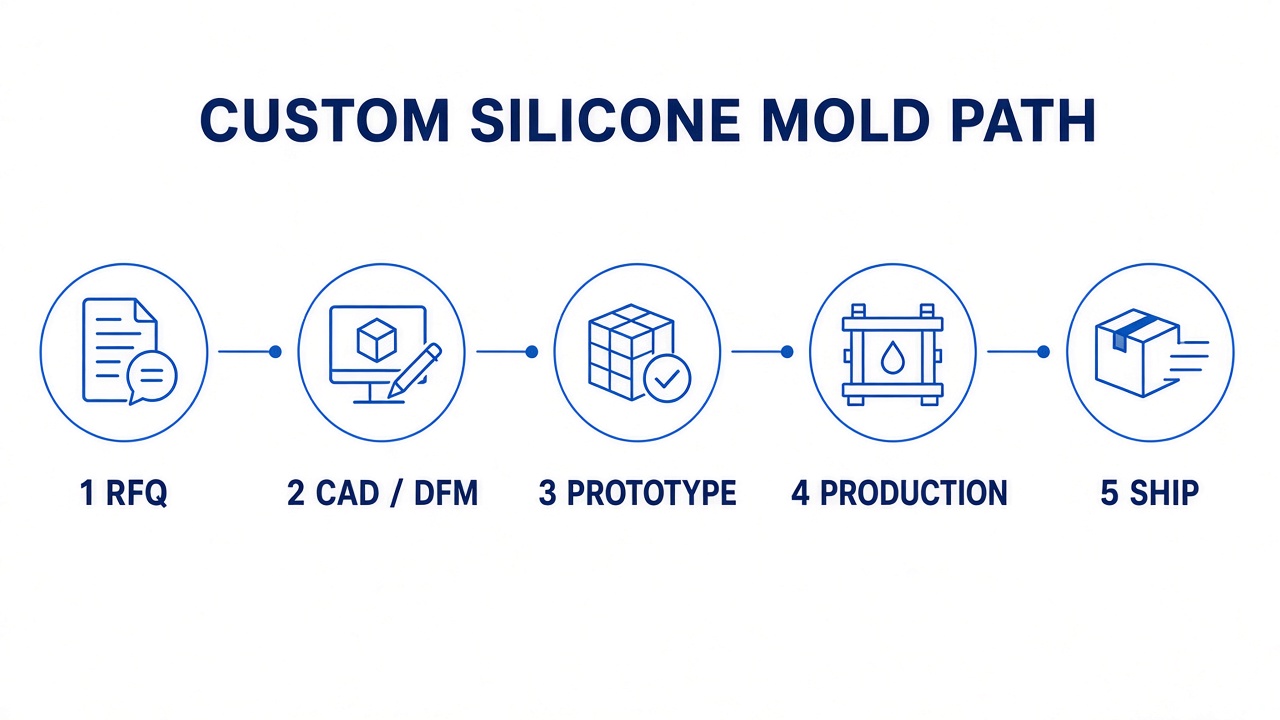
Route the RFQ from what actually ships: if Reusable RTV cavity, go to an RTV master-and-jacket quote on the WYD quote form; if Molded silicone part, go to Undercut vs straight pull; if Must stretch / 10A class prototype mold, go to Aluminum or RTV prototype mold, then split or core in steel; if Thousands, millable HCR, split allowed, go to HCR compression: mill, preform, flash land, deflash; if Higher annual, LSR grade, automation, go to LSR injection: cavity heat, gates, vents, cold-runner.
Geometry and what actually ships override the process name. A tiny bellows at 400 pcs/year is still a compression job. A deep undercut at 50,000 pcs still needs side actions no matter which rubber family you pick.
RFQ comparison bands: 70 × 40 mm bellows with a 5 mm barb
| Route | Typical first qty | Hardware | Typical shrink allowance | Typical drawing class |
|---|---|---|---|---|
| RTV prototype mold / jacket | 20-50 | Master + box + jacket | Platinum RTV ~0.1-0.3% | Cavity, not a rubber-article class |
| HCR compression | Low thousands | Two-plate, flash land, platen or cartridge heat | ~1.5-2.5% | ISO 3302-1 M2 unless the 2D says M1/M3 |
| LSR + cold-runner | High annual, automation | Steel, cavity heat, gates/vents, cold-runner | ~2-3% (grade/temp) | Same drawing class + first-article inspection (FAI) remeasure |
These are shop-normal bands for RFQ comparison, not a named lot.
FAQ
Why is Shore 20A the wrong peace treaty when stretch and tear fight? Shore A tells you how easily the pin indents; it does not tell you whether the part will zipper at the undercut. If durometer and tear fight, do not pick 20A as a compromise. Split the steel, or prototype a soft skin inside a rigid jacket.
Can a high-tear 30A still trap a hooked part? Yes. A 30A with excellent tear still may not elongate enough to clear a hook. You will not feel that on a datasheet Shore line; you will feel it when the part wedges. 40A and up start to behave like a stiff shoe: you will tear the rubber or break the core.
When should I add a split instead of dropping durometer? When a sharp re-entrant, a through-hole off the draw, a flange wider than the body, a thread, or a barb will not survive elongation every cycle you care about. A split line through the lock turns an undercut into a straight pull so you can step into 20-40A and hold the cavity. You pay a flash line on the part.
How thick should a 10A glove skin be over a deep hook on a prototype mold? Match skin thickness to the smallest lock. Too thick, and even 10A will not elongate over a deep hook. Too thin, and you tear or print jacket seams. Freeze Shore only after a pull coupon that includes the actual lock and the actual sharp inside corner.
Will hunting a 5A catalog grade save a square hook that already tears 10A high-tear? No. If even 10A high-tear wants to tear, the answer is geometry: add a split, add a core, or radius the lock. Durometer selection cannot repeal a square hook. Sticky face on a 3D-printed master is inhibition, not hardness.
Ready to order custom silicone molds?
Send your drawing, sample or project requirements for DFM and quotation.