
One Frame or Three Stock Molds? Lock the Tray Envelope First
Buyer decision: one shared outer frame with cavity inserts vs three stock silicone trays - when the depositor, rack, and wash already share one envelope. Showcase Shorts are not line proof.
On this page
Should you buy three ready-to-use silicone trays for three shapes, or one shared outer frame with a swapped cavity insert per SKU? Lock the tray envelope first. If purchasing is shopping "three ready-to-use moulds for multiple tray formats," the cheap path is three unrelated trays - and the line then gets three pitches, three rack heights, and three demold habits. A shared outer frame with inserts only wins when the depositor, the rack, and the wash already agree on one envelope. This post owns that buy decision for deposit lines; it is not a retitle of custom silicone gummy molds.
Watch the short video on YouTube
Showcase Shorts are plant context - not proof of your three SKUs, your depositor pitch, or a passed piece-weight check.

Which buy matches the line
| What is actually fixed | What to buy | What to refuse |
|---|---|---|
| Three shapes, one depositor pitch, one rack, one wash | One outer frame, cavity insert per SKU | Three stock trays with three different outlines |
| Three shapes and three different pitches already on the floor | A tray per pitch, quoted as separate tools | One "universal" tray that makes the nozzles miss the outer row |
| Shape still changes every week | One soft sample of the riskiest SKU | Three production tools on an unlocked logo |
| You only need a plain bear the starch mogul already hits | Stay on the starch boards | A silicone photo that looks cleaner |
Product context stays on the commercial pages: gummies on custom silicone gummy molds; chocolate pieces on custom silicone chocolate molds. Starch mogul versus a silicone deposit tray is a different decision - do not treat a nicer silicone photo as proof you should leave starch. That split is on silicone or starch for edible gummies.
When one frame is the right tool
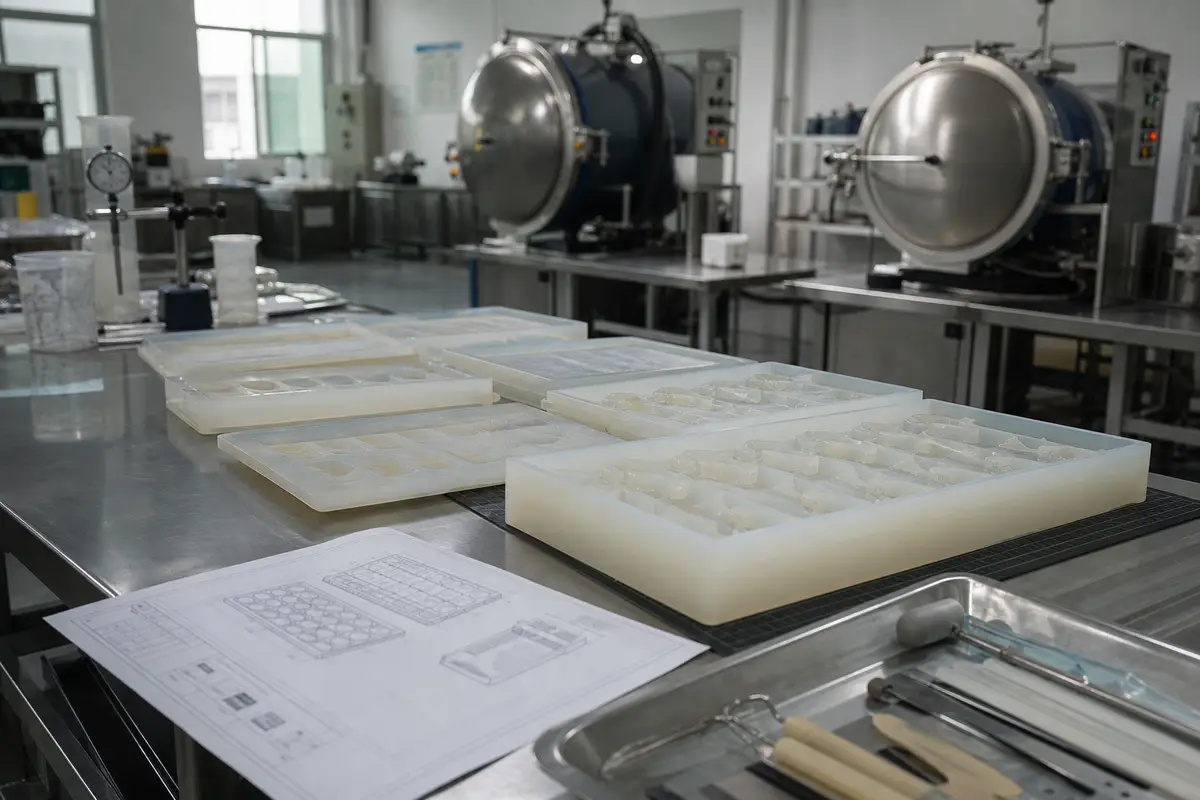
One frame earns the PO when the nozzles, the tray support, and the cooler already share an envelope. We then treat each SKU as a cavity insert: piece weight, logo, and cavity count can change, and the operator does not re-teach the outer row.
- Deposit the same pitch on every SKU. If SKU B needs a wider tray, it is a second tool - not a "universal" insert fantasy.
- Outer cavities go light when the loaded tray sags. Fix the support before you add a fourth stock mold. Run a full-load sag check on the production line first.
- A logo that is sharp in CAD can still lock the piece at the deposit station. Approve on your formula, not on water.
- Piece weight is a method, not a caption. Stage edge and center cavities the way the weigh note describes: verify piece weight and cavity fill. This post does not rewrite that method.
What one frame will not fix
It will not make three depositor pitches into one. It will not turn a starch mogul into a depositor line. It will not prove dose, a label claim, or a market license. Food-contact paperwork, when you need it, follows the compound and the destination market. We do not call the factory FDA-approved.
Three stock molds still make sense when the shapes are unrelated and you will not repeat them. Paying for a shared frame on a one-week seasonal bear is the expensive version of a sample.
What the clip is for
Use the short to see how a custom mold is built on this floor. Then ignore anything it does not show: your pitch, your set time, your three weights. Acceptance is a weighed piece from each SKU, off your formula - not a walkthrough video.
Timing and commercial framing
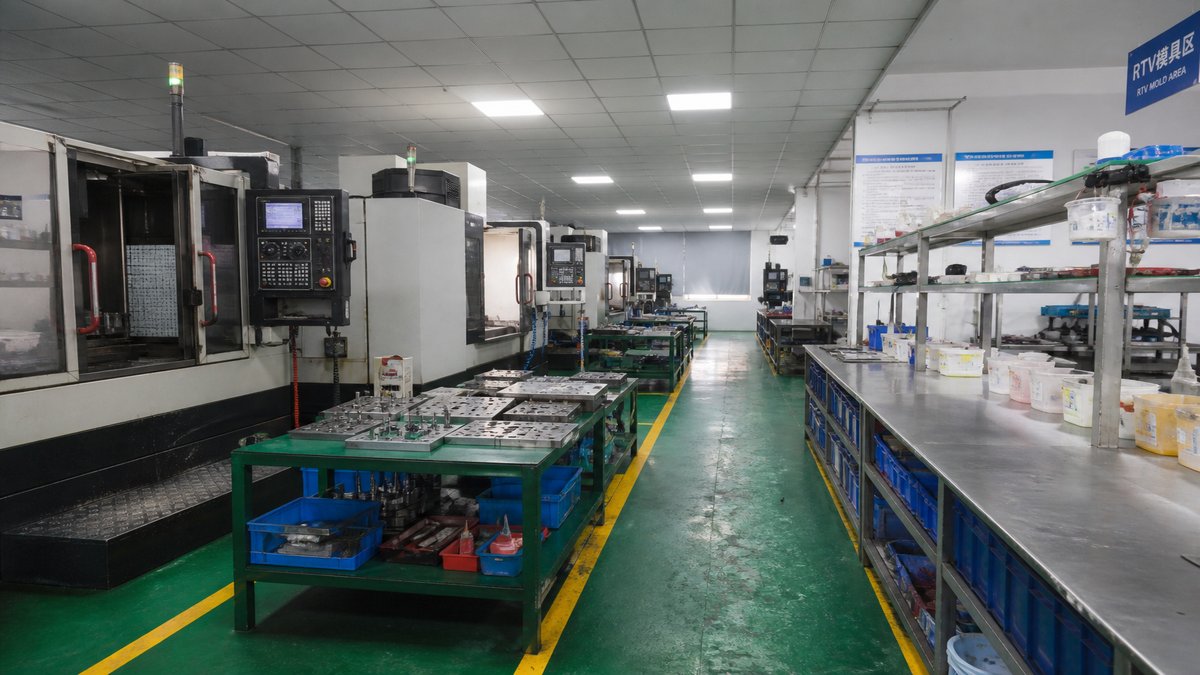
WYD quotes custom silicone molds from Bao'an (since 2006). Soft-mold commercial floors often cite about 20 molds per approved design on applicable small-batch programs. That floor is an order minimum, not a process switch, and it is not a universal MOQ for every HTV, LSR, or industrial tool.
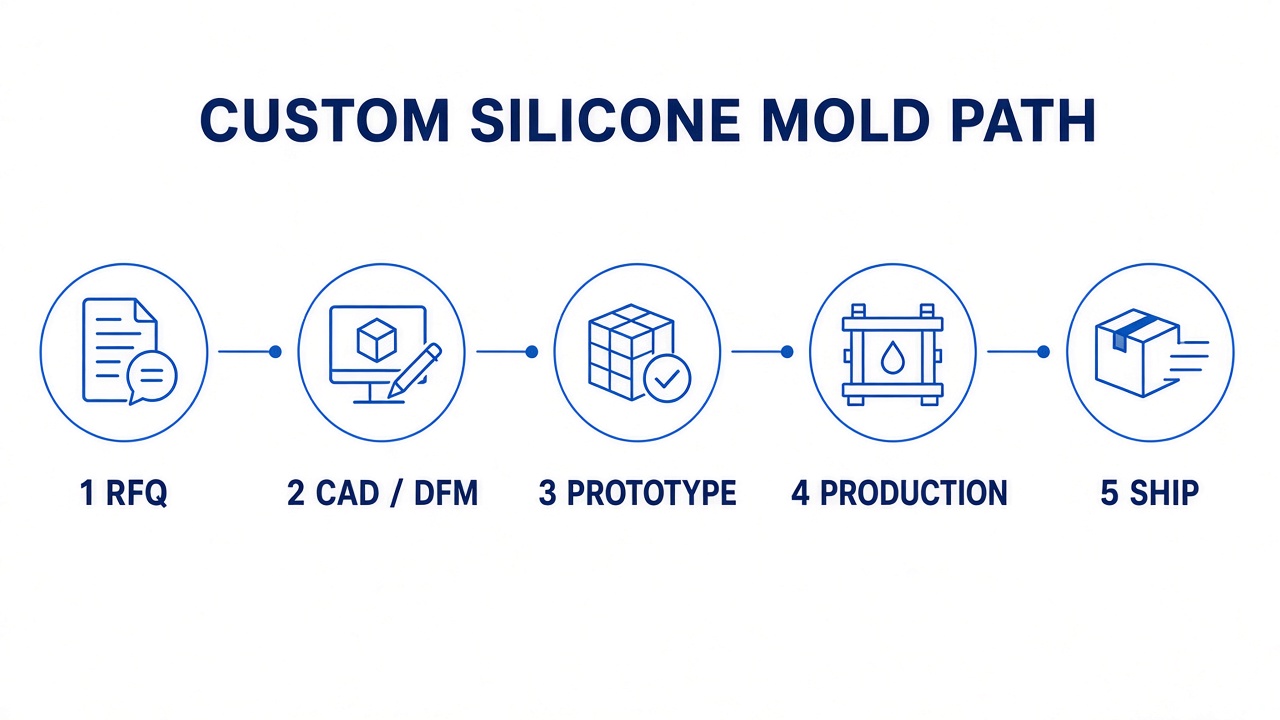
Planning estimates we use on current quotes (shipping separate):
- Reply: typically within 12 hours
- CAD / DFM: 1-3 business days
- Prototype: typically 3-5 business days after CAD approval
- Small batch: typically 2-3 business days after sample approval
- Standard production: typically 7-10 business days after approval
- Large or complex projects: timeline confirmed by project
Timelines are typical planning estimates and may vary with design complexity, revisions, material, tooling method, quantity and testing requirements. Shipping and transit time are separate.
DFM review is free. Simple 3D modeling can start from about USD 50; complex shapes are quoted separately. Do not treat USD 50 as a flat fee for every drawing change, and do not treat it as a tooling deposit. Route honesty lives on capabilities when you compare soft molds against other paths.
What to send for a quote
- The three shapes (photo, sketch, or CAD), and which one is still moving.
- Depositor pitch, nozzle map, or a clear note that deposit is by hand.
- Target piece weight and cavity count for each SKU.
- Tray envelope the rack and wash already accept (outer size, height, support points).
- First quantity per SKU, and whether the frame should be tooled for a later insert.
A sample tray and a production frame are separate lines on the quote. Send that pack through contact.
FAQ
Are three ready-made molds faster than one custom frame? Sometimes for a one-off shape. They are slower when the line has to re-teach pitch and the outer cavities miss weight. Speed is not the same as line fit.
Can one frame run gummies and hard candy? Do not plan on it. Cook temperature and release are different jobs. Quote them as separate tools unless the factory has already proven the shared envelope on your formulas.
Does MOQ 20 cover three SKUs? The soft-mold floor is often 20 pieces per approved design, on programs where that floor applies. Three designs are three counts unless the quote says the insert set is treated as one design. Confirm on the written quote - do not assume a shared frame collapses three SKUs into one MOQ line.
Ready to order custom silicone molds?
Send your drawing, sample or project requirements for DFM and quotation.