
Silicone should be specified by the application and required evidence, not by a marketing label alone.
Terms such as:
- “food grade”
- “medical grade”
- “platinum silicone”
- “high-temperature silicone”
are incomplete unless the buyer also defines:
- what the silicone will contact
- the operating environment
- the manufacturing process
- target market
- required documentation
- the final performance that must be validated.
Material options and available documentation should be reviewed against the selected compound, application and target market.
Start With the Manufacturing Process
The material family is linked to the process.
HCR / HTV Silicone
High-consistency silicone rubber is commonly used in compression molding.
Applications can include:
- trays
- gaskets
- covers
- grips
- keypads
- kitchenware
- industrial components.
The exact grade, cure system and post-cure requirement depend on the product and specification.
LSR — Liquid Silicone Rubber
LSR is a two-component liquid silicone system used in injection molding.
It may be evaluated when:
- the material system itself is specified
- liquid injection suits the geometry
- thin/detail features benefit from injection
- automation or insert molding matters
- production volume justifies the tooling route.
LSR is not automatically “better” than HCR/HTV.
RTV Silicone
RTV silicone cures at room temperature and is commonly used for flexible casting molds.
A typical route may be:
approved master → RTV silicone mold → test casting
RTV projects can include:
- resin
- plaster
- candle
- soap
- sculpture
- other casting applications.
The finished mold may be one-piece, split or supported by a rigid mother mold.
Cure System Is Not a Simple Quality Ranking
Buyers often ask:
> “Is platinum-cure always the best?”
No single cure system is universally best.
Platinum-cure systems
Can be selected where:
- a specific low-byproduct material system is required
- food-contact documentation is needed for the selected compound
- LSR processing is used
- odor/volatile targets matter.
Peroxide-cure systems
Are used in many HCR/HTV applications.
Depending on the compound and end use, a post-cure may be specified.
RTV cure chemistry
RTV systems can use different cure chemistries and should not be collapsed into the same HCR platinum/peroxide decision.
The correct specification begins with:
- process
- application
- contact condition
- supplier material data
- required documentation.
Do not use “platinum” as a substitute for a complete specification.
Shore A Hardness Does Not Equal Final Product Stiffness
Shore A measures material hardness.
It does not fully define how a finished silicone part feels or behaves.
Final behavior also depends on:
- wall thickness
- span
- ribs
- geometry
- preload
- cavity size
- local flex features
- support structure.
A wide thin tray may sag even with a relatively firm compound.
A locally thin gasket lip can flex even when the main body is harder.
Material hardness should therefore be reviewed with geometry and function.
Food-Contact Documentation Must Match the Actual Use
For food-contact projects, identify:
- market
- food type
- contact temperature
- contact duration
- single or repeated use
- cleaning
- selected compound
- buyer/customer-specific requirement.
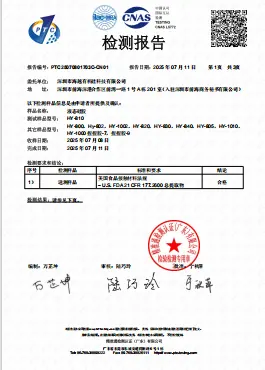
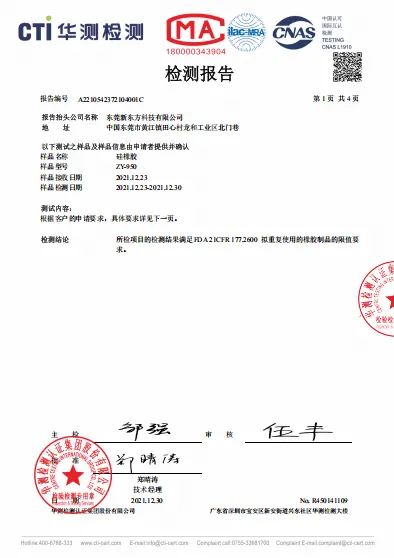
For U.S. programs, buyers may reference applicable requirements for rubber articles in repeated food contact, including 21 CFR 177.2600 where relevant.
For EU programs, the buyer may reference:
- Regulation (EC) No 1935/2004
- Regulation (EC) No 2023/2006
- additional national, technical or customer requirements.
The correct document path depends on the actual product and compound.
Do not present a supplier report as an “FDA approval certificate” for the factory.
Do not present one report for one compound as proof for every finished silicone article.
Food-Contact Documentation and Thermal Performance Are Different
A material can have food-contact documentation and still require a separate thermal/structural validation.
For a baking tray, the buyer still needs to confirm:
- actual oven condition
- dwell
- loaded behavior
- cleaning
- repeat use.
For a freezer mold, the buyer still needs to confirm:
- frozen release
- tray flex
- repeated cycling.
Compliance evidence and functional validation should be treated as separate parts of the approval plan.
Medical and Healthcare Projects Need a Defined Requirement
“Medical grade silicone” is not a complete RFQ.
Ask the buyer to define:
- component function
- patient/contact type
- contact duration
- sterilization or cleaning
- material specification
- traceability
- required standard/test
- target market
- device-manufacturer requirements.
A material supplier may have biocompatibility or other test data for a specific grade.
That does not automatically establish approval of the buyer's finished device.
Material/process feasibility and documentation scope should be reviewed against the defined project rather than a blanket grade label.
Industrial Material Selection Starts With the Environment
Silicone is useful in many industrial applications, but it is not the best elastomer for every fluid or environment.
Specify:
- heat
- cold
- oil
- fuel
- cleaner
- chemical
- pressure
- compression
- outdoor UV/weather
- flex
- sealing
- electrical environment where relevant.
For chemical compatibility, provide:
- chemical name
- concentration
- temperature
- exposure duration
- static or dynamic condition.
A generic “chemical resistant silicone” statement is not enough.
What the Common Documents Actually Do
TDS — Technical Data Sheet
Provides technical properties and supplier data for the material grade.
Use it to understand:
- hardness options
- physical properties
- processing guidance
- temperature information
- other grade-specific properties.
It is not a finished-product inspection report.
SDS — Safety Data Sheet
Provides hazard, handling and safety information for the material.
It does not prove final-product compliance.
CoA — Certificate of Analysis
May provide batch/lot data against defined supplier specifications.
Availability and content depend on the material supplier and program.
Food-contact / regulatory test report
Supports a specific compound/test scope.
Confirm:
- exact grade
- pigment/color where relevant
- test scope
- report date
- applicable use.
Material declaration / customer compliance form
Used where the buyer needs a supplier declaration against a defined requirement.
The declaration is only as meaningful as the material and scope it references.
Color and Pigment Are Part of the Material System
For controlled applications, color should not be treated as a purely cosmetic afterthought.
A change in:
- pigment
- masterbatch
- material supplier
- compound
- post-cure
can affect the approved material/document package.
When documentation matters, freeze the exact approved material/color system before repeat production.
Post-Cure Should Be Project-Specific
Some silicone compounds or applications may require post-cure.
The correct process depends on:
- compound
- supplier recommendation
- intended use
- volatile/odor target
- compliance/test route.
Do not publish one universal post-cure recipe for all silicone parts.
Where post-cure is important, it should be documented as part of the production process.
What to Send for a Material Review
Provide:
Application
- what the silicone does
- what it contacts
- whether it seals, flexes, stretches or supports load.
Environment
- temperature
- chemicals/fluids
- UV/weather
- cleaning
- pressure/compression.
Manufacturing
- HCR/HTV, LSR, RTV or unknown
- geometry
- target Shore if already validated.
Compliance
- target market
- food/skin/healthcare contact
- requested standard
- required reports/declarations
- customer-specific specification.
Commercial
- first quantity
- annual/repeat volume
- target date.
If the material is not yet specified, send the application first. The material route should follow the requirement.
Send a project for review
Send the file or sample, the function, and the quantity.