
Thermal Expansion vs Shrink in Heat-Cured Silicone
Silicone CTE is about 250-300 ppm/°C. Heat-cure and post-cure move parts. Compensate from coupons. Do not confuse reversible expansion with HCR or LSR shrink.
On this page
If you're calling a tight tolerance on a heat-cured silicone part, two hundred fifty to three hundred ppm per degree C is not a small number on a 200 mm tool.
Linear CTE for typical PDMS silicone sits roughly in that band (on the order of 250-300 × 10⁻⁶ /K). Aluminum is around 23 ppm/°C. Tool steel is around 12. A silicone part that you heat-cure, post-cure, or fill with a hot resin is moving ten to twenty times more than the metal around it. If you call ISO 3302-1 M1 on a heat-cured article and ignore that motion, the drawing is fiction.
Expansion on heat is mostly reversible. Cure shrinkage and post-cure mass loss are not. Mixing the two into one heat factor is how first articles come in small, then grow in the oven, then argue in inspection.
Do not stack CTE on top of shrink
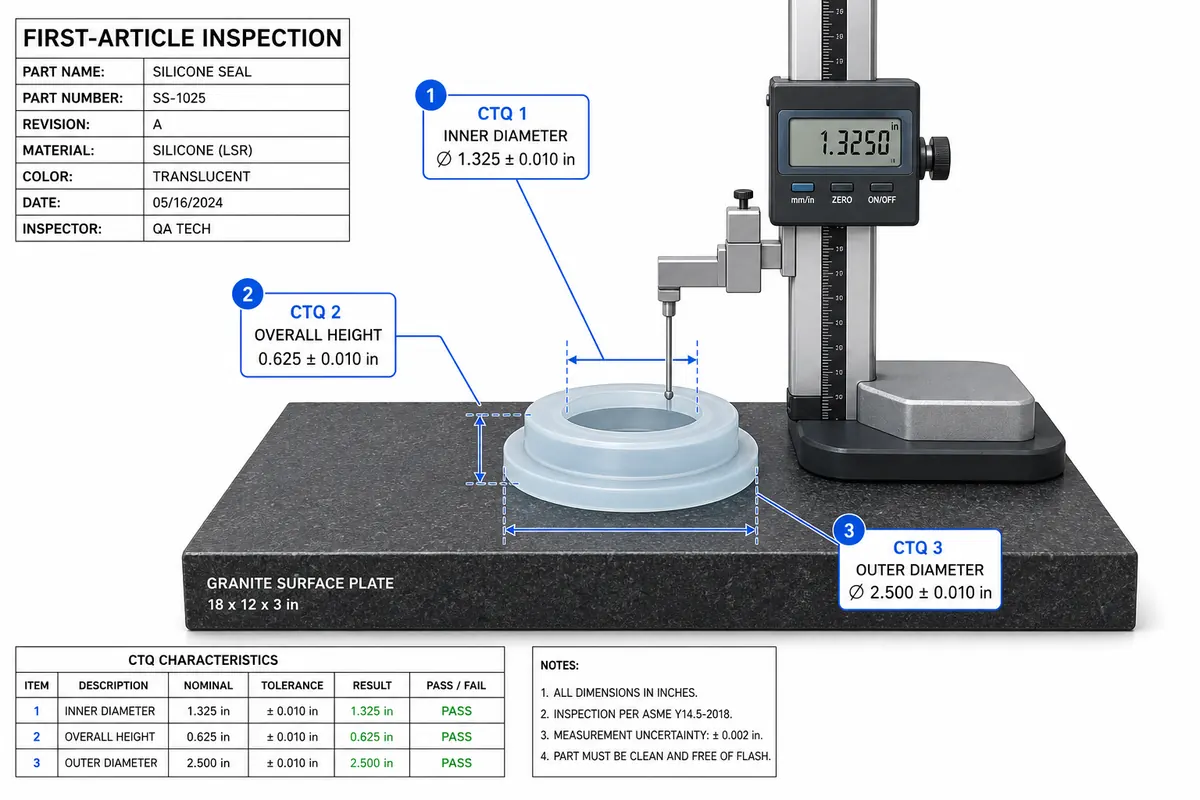
Buyers add CTE × ΔT on top of a 2.5% LSR shrink factor, then blame the shop when first-article inspection (FAI) is long. The shrink factor already includes cool-down from cure temperature in a proper coupon. CTE still matters for a hot rubber cavity (an RTV prototype mold used warm). Paying a tooling charge on a cover photo does not tell you which number was cut into the steel.
A 100 mm ID gasket is three freezes of size
Say you need a 100 mm ID gasket, 3.2 mm section, Shore 50A, 60 validation pieces and about 8,000 a year, measured at 23 °C after post-cure.
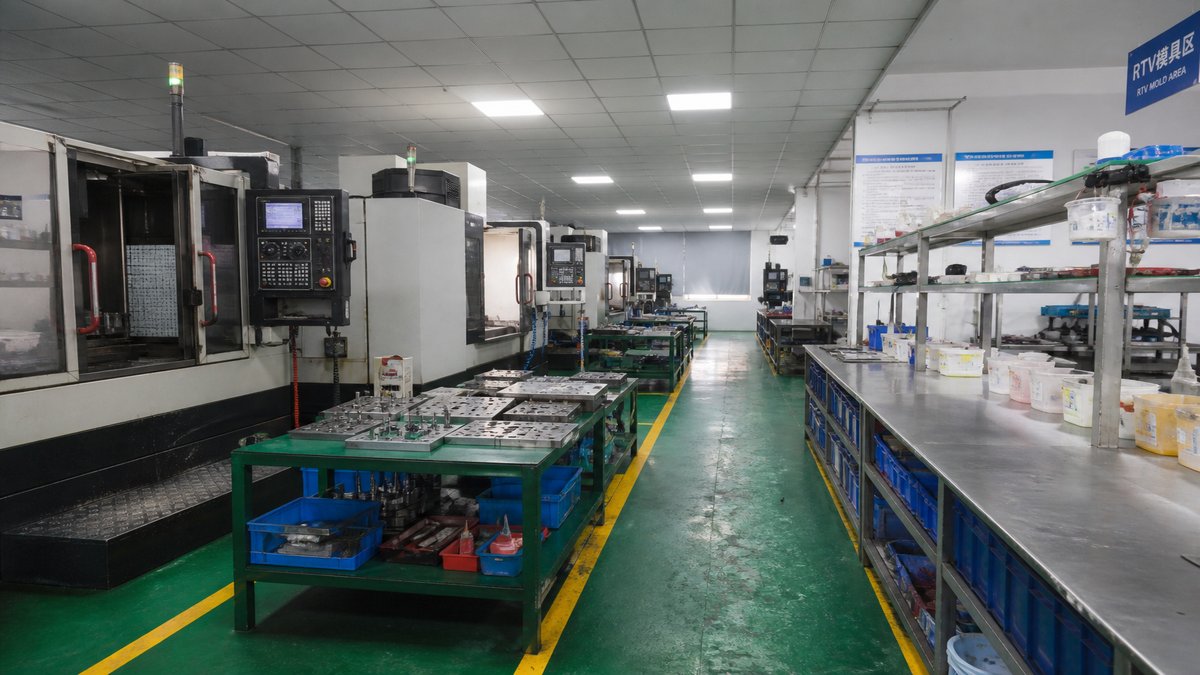
For the 60, a shop may run an aluminum one-cavity HCR tool cooler than production steel-size will not match unless you say so.
For a few thousand millable gaskets, you'll usually cut a heated two-plate HCR tool with a ~1.5-2.5% shrink allowance from a coupon.
If annual volume justifies LSR, the production tool needs cavity heat, gates, vents, and usually a cold-runner, with ~2-3% shrink. Don't call that a “LIM hot tool.” The cavity is heated; the runner, when it's a cold-runner, is kept cool. Those three PDFs can all say “mold cost.” You're not buying the same freeze of size.
Checks before you freeze a shrink factor

Before you compare prices, get answers on:
- Process: HCR compression vs LSR injection (cold-runner vs dump-runner) vs RTV prototype mold only for geometry?
- Shrink factor from a coupon of this compound after this post-cure-not a catalog midpoint?
- Measure at 23 °C after the named post-cure? ISO 3302-1 class on the drawing (M2 is a common default)?
- Aluminum or steel, and will the prototype press run cooler than production?
- Who owns the plates and inserts after the tooling charge, and can you move the tool?
If those lines are missing, the cheaper quote is usually the incomplete one.
Reversible swell from heat versus permanent cure shrink
Thermal expansion. The network is already formed (or the gum is still green). Raise temperature, the part gets larger. Cool it, it comes back, minus whatever viscous set and whatever chemistry happened while it was hot. For a cured rubber sitting in a hot press or a hot jacket, this is the live cavity size at temperature.
Cure shrinkage. Crosslinking and loss of volatiles reduce the dimensions you will measure at room temperature later. Heat-cured HCR commonly lands around 1.5-2.5%; LSR around 2-3%, depending on grade, temperature, pressure, and post-cure. That is a permanent offset you cut into the steel. Platinum RTV mold rubber is typically about 0.1-0.3% after a proper room-temperature cure. Tin-cure RTV shrinks more and keeps moving. Don't apply the heat-cure band to a poured platinum prototype mold.
Post-cure. Extra heat after demold drives off cyclics and, in peroxide HCR, decomposition products. The part can shrink again. Optical and food-contact lots need this bake. Precision lots must be measured after the bake you will actually run, not after press cure only.
If you heat a platinum RTV prototype mold to accelerate cure or to cast a warm resin, you are mostly in the reversible-CTE regime, plus a little extra crosslinking. If you compression-mold HCR at 170 °C and then post-cure at 200 °C, you are in shrink-plus-CTE, and the steel must already know both.
Rubber moves far more than aluminum, far more than steel
Order of magnitude, linear, for a 100 °C rise on a 100 mm length:
- Tool steel: on the order of 0.1 mm
- Aluminum: on the order of 0.2 mm
- Silicone at about 250-300 ppm/°C: on the order of 2.5-3.0 mm
Those are back-of-envelope figures from published CTE bands, not a lab report on your compound. Measure your grade if the tolerance is real.
Consequences in heat-curing:
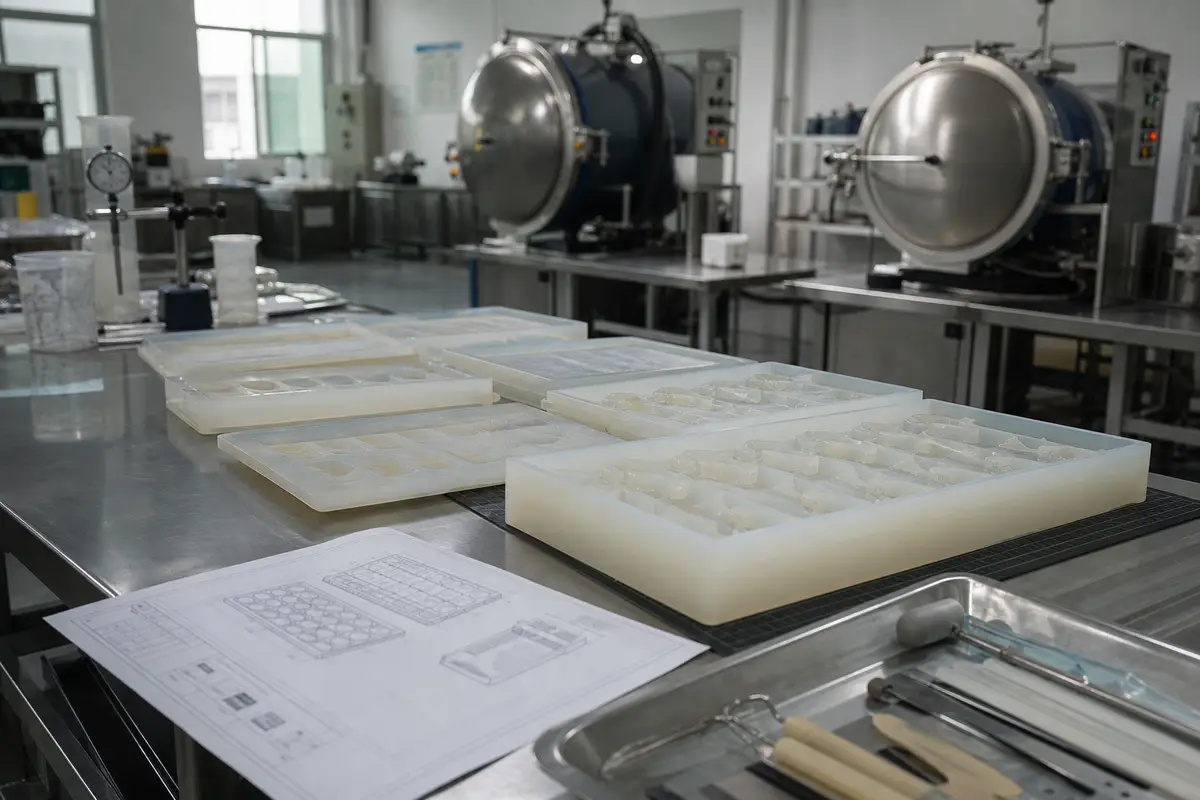
- A soft RTV prototype mold in a rigid jacket: at pour temperature the rubber wants to grow. If the jacket prevents it, the cavity shrinks relative to the free rubber. If the jacket is loose, the cavity grows and you cast a fat part.
- An LSR/HCR part in a hot steel tool: the steel is the size standard at cure temperature. The rubber then contracts on cool-down plus cure shrink. That combined freeze is why shrink factors are not equal to CTE times delta T.
- A silicone part used as a trapped-rubber or bladder tool in composites: CTE is a process feature. The rubber loads the laminate as it heats.
Wall thickness changes the thermal lag. A thick boss is still growing when a thin lip has already peaked. Differential expansion prints warp and oval, then inspection calls it tolerance.
Heat-cure cycles that print a size error
Accelerating platinum RTV in an oven. the prototype mold is on the master. Both grow. Coefficients differ (resin print, aluminum master, plaster). The rubber copies the hot master, then both cool. If the master CTE is much lower than the rubber, the rubber can be in tension on cool-down and the cavity at room temp is not the CAD model.
LSR injection. Cold-runner, hot cavity. Cure temperature and post-cure both belong in the shrink factor. Changing post-cure time after steel is cut moves the part.
HCR compression / transfer. Charge mass, pressure, and temperature change density and shrink. A prototype aluminum tool run cooler than production steel will not print the same size.
Post-cure of a molded part on a rack. Unconstrained thin sections shrink freely. Constrained thick sections, or parts stacked, shrink less or warp. If the print requires a press-fit, post-cure the way production will, including orientation.
Hot resin or low-melt alloy in an RTV cavity. The cavity is larger while hot. The casting solidifies at some temperature in between. Then the rubber cools and grips. Jacket the mold if you need the room-temperature cavity, not the hot cavity.
Compensate the cavity from measured coupons, not folklore
- 1. Mold a coupon in the real compound, real thickness band, real cure, real post-cure.
- 2. Measure at room temperature after 24 h, then after the post-cure you will ship.
- 3. Derive one shrink factor per process (platinum RTV, tin RTV, LSR, HCR). Don't reuse a 2.5% LSR number on a platinum glove prototype mold.
- 4. Cut metal steel-safe on critical bores if you can afford a recut. Rubber prototype molds get a recast cheaper than a recut, but only if you measured.
For an RTV prototype mold that must hold a tolerance while you heat-cure a casting, add a thermal step: measure the cavity cold, heat to process temperature in the jacket, measure or cast a witness, cool, measure again. The delta is your live expansion, not the datasheet CTE in isolation.
Humidity and swell from solvents are additional reversible moves. A part washed in acetone and measured wet is a swollen article. That is not CTE, but inspection will not care.
Callouts that no silicone tool can hold
Silicone is the wrong cavity material for SPI Class 101 steel thinking. Rubber plus 250-300 ppm/°C plus a 1.5-2.5% HCR or 2-3% LSR shrink band, or a near-zero platinum RTV shrink, does not hold 0.05 mm on a 150 mm housing unless you control temperature at measurement, jacket the prototype mold, and freeze the cure recipe.
Write the drawing in this language:
- Measure at 23 °C after the named post-cure.
- Mold process: LSR, HCR, platinum RTV, or tin RTV, jacketed or unjacketed.
- Shrink factor from coupon lot, not from a catalog midpoint.
- Critical fits: steel or machined insert, not the rubber face.
- ISO 3302-1 class (M2 is a common default). That class is not a synonym for “precision.”
If the buyer needs metal tolerances, sell a metal tool. If they need undercuts and a peel, sell rubber and an honest tolerance class. Heat-curing does not make silicone behave like steel. It makes the CTE impossible to ignore.
When this article is the wrong quote
If you need a reusable RTV cavity (gummy, chocolate, resin) rather than a vulcanized silicone part, the live-cavity CTE story still applies-but the quote is a master + box + jacket job, not HCR/LSR steel. A cheap aluminum one-cavity can beat both a full LSR cold-runner and a large RTV stack when the gasket is tiny and annual quantity is only a few hundred. Geometry and what actually ships override the shrink slogan on the RFQ.
Related reading: material shrinkage rate, silicone mold tooling explained, LSR vs HCR prototype tooling, design-for-manufacture (DFM) for silicone parts.
What to send for a size quote
Copy this into the RFQ.
- STEP/STL and 2D with critical dimensions and a rubber tolerance class (often ISO 3302-1 M2)
- What ships: molded silicone part, or a flexible cavity
- Target Shore A, polymer family (HCR / LSR), post-cure T/t/thickness
- First quantity and annual quantity
- Process preference: HCR compression vs LSR injection (cold-runner vs dump-runner)
- Measure at 23 °C after that post-cure; coupon shrink, not catalog midpoint
- Who should own plates/inserts after the tooling charge
Send the STEP file, the post-cure, annual quantity, and HCR vs LSR preference. That is enough for a plate-stack sketch before anyone mills steel.
Do not add CTE as a second shrink factor
Do not add CTE × ΔT as a second shrink factor for steel cut, or cutting a steel LSR tool with a cold-runner before a 100 mm gasket has run as a one-cavity HCR prototype mold-unless annual volume and automation are already on the PO. Do not freeze size from an aluminum tool run cooler than production steel. Do not treat a tooling charge as ownership.
WYD Prototype → Compression → LSR (use this on the RFQ, then ignore quantity if geometry disagrees):
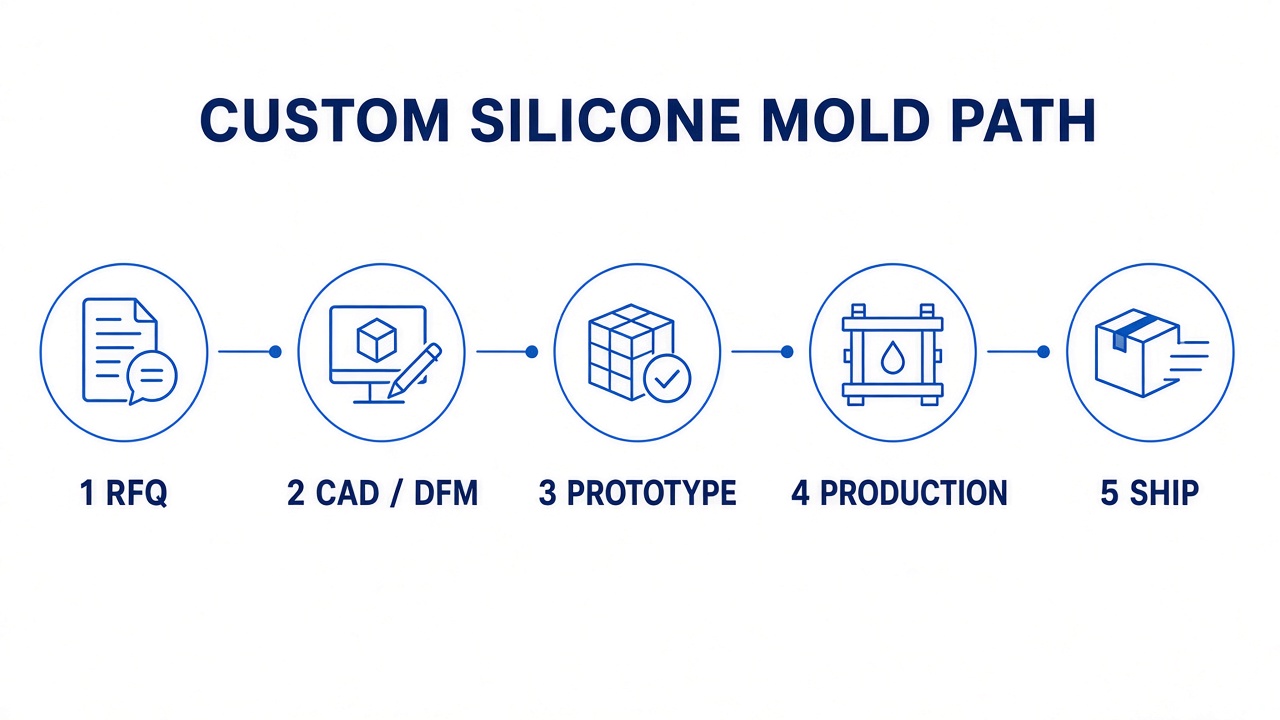
Route the RFQ from what actually ships: if Reusable RTV cavity, go to an RTV master-and-jacket quote on the WYD quote form; if Molded silicone part, go to Annual quantity and freeze of size; if Tens to low hundreds / validation, go to Aluminum one-cavity prototype mold; size is a witness; if Thousands, millable HCR, simple shut-off, go to HCR compression: mill, preform, flash land, deflash; if Higher annual, LSR grade, automation, go to LSR injection: cavity heat, gates, vents, cold-runner.
Geometry and what actually ships override the process name. A tiny gasket at 400 pcs/year is still a compression job. A deep undercut at 50,000 pcs still needs side actions no matter which rubber family you pick.
RFQ comparison bands: 100 mm ID gasket
| Route | Typical first qty | Hardware | Typical shrink allowance | Typical drawing class |
|---|---|---|---|---|
| RTV prototype mold / jacket | 20-50 | Master + box + jacket | Platinum RTV ~0.1-0.3% | Cavity, not a rubber-article class |
| HCR compression | Low thousands | Two-plate, flash land, platen or cartridge heat | ~1.5-2.5% | ISO 3302-1 M2 unless the 2D says M1/M3 |
| LSR + cold-runner | High annual, automation | Steel, cavity heat, gates/vents, cold-runner | ~2-3% (grade/temp) | Same drawing class + FAI remeasure |
These are shop-normal bands for RFQ comparison, not a named lot.
FAQ
Is silicone CTE the same number as the 1.5-2.5% HCR or 2-3% LSR shrink I cut into steel? No. Expansion on heat is mostly reversible. Cure shrinkage and post-cure mass loss are not. Mixing the two into one heat factor is how first articles come in small, then grow in the oven, then argue in inspection. Do not apply the heat-cure shrink band to a poured platinum prototype mold.
How much more does silicone move than the metal around it? Linear CTE for typical PDMS sits roughly in the 250-300 ppm/°C band. Aluminum is around 23 ppm/°C and tool steel around 12. On a 100 °C rise over 100 mm, that is on the order of 2.5-3.0 mm for silicone versus about 0.1 mm for steel. Those are back-of-envelope figures from published bands; measure your grade if the tolerance is real.
Why did an oven-accelerated platinum RTV cavity not match CAD? the prototype mold is on the master; both grow, then both cool. If the master CTE is much lower than the rubber, the rubber can be in tension on cool-down and the room-temperature cavity is not the CAD model. For precision, cure RTV at the temperature you can live with, fixture the master, or measure the offset.
Can a silicone part hold 0.05 mm on a 150 mm housing? Not unless you control temperature at measurement, freeze the cure recipe, and pick an honest ISO 3302-1 class. Rubber plus that CTE plus a heat-cure shrink band does not hold SPI Class 101 steel thinking. If the buyer needs metal tolerances, sell a metal tool; if they need undercuts and a peel, sell rubber.
Does a part washed in acetone and measured wet count as thermal expansion? No. Humidity and solvent swell are additional reversible moves. A swollen article is not CTE, but inspection will not care. Dry fully before FAI if the dimension is a fit.
Ready to order custom silicone molds?
Send your drawing, sample or project requirements for DFM and quotation.