
ISO 10993 vs USP Class VI: Medical Silicone Meaning
USP Class VI is an acute plastics screen. ISO 10993 evaluates the finished device in use. Neither stamp makes a part medical. Write the real test.
On this page
If you're putting “medical-grade silicone” on an OEM RFQ, Class VI is a plastics screen. 10993 is a device-risk standard.
Neither one is a yellow sticker that turns a drum of gum into a medical device. Catalog language usually means: this compound has been tested to a named biological screen, often USP Class VI, sometimes selected ISO 10993 endpoints, on a defined specimen. Your molded article, with your pigment, your post-cure, your mold-release, and your sterilization, is a different test article. FDA device submissions and EU MDR expect a biological evaluation of the finished device in its intended contact, not a Class VI certificate photocopied into the DHF.
Medical paths are almost always platinum addition-cure (LSR or platinum HCR; platinum RTV only as a geometry prototype mold). Peroxide HCR can be formulated for healthcare in some lines after a serious post-cure. Tin-cure RTV is the wrong starting chemistry.
Class VI is not junior ISO 10993
People treat USP Class VI as a lighter ISO 10993. It is not a subset. Paying a tooling charge on a cover photo does not stamp the SKU “ISO 10993 certified.” 10993 is not a product mark. Don't call the LSR stack a “LIM hot tool.” The cavity is heated; a cold-runner is kept cool.
What a 12 mm septum RFQ is actually asking
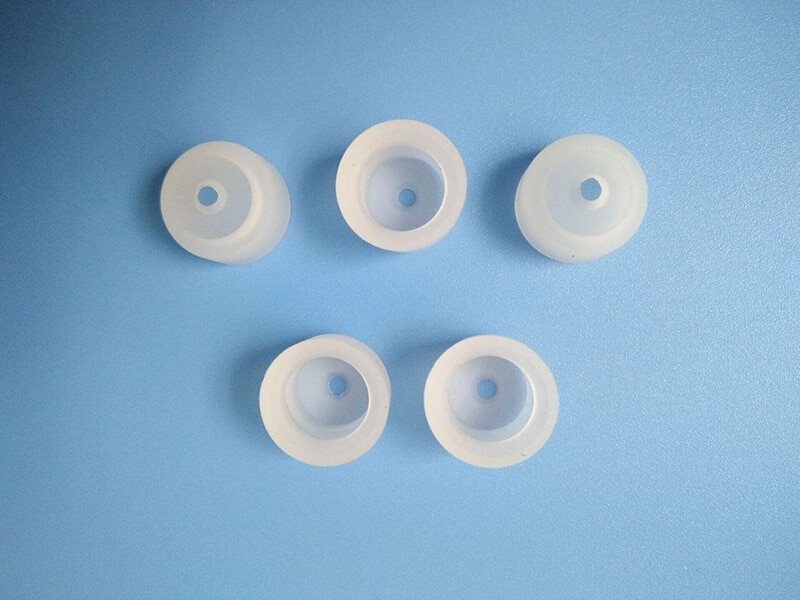
Say you need a 12 mm silicone septum, Shore 50A, 200 validation pieces and about 40,000 a year, prolonged fluid-path contact.
For the 200, a shop may run an aluminum one-cavity-or an RTV prototype mold only to check geometry. Neither prototype mold nor plaque of natural LSR is the sterilized, pigmented device.
For a few thousand millable septa, platinum HCR compression can be honest. Typical shrink ~1.5-2.5%.
If annual volume justifies LSR, the production tool needs cavity heat, gates, vents, and usually a cold-runner. Typical shrink ~2-3%. Those three PDFs can all say “medical mold.” You're not buying the same file.
Healthcare questions a molder can answer
Before you compare prices, get answers on:
- Contact type and duration (surface / externally communicating / implant; limited / prolonged / permanent)?
- Compound: platinum LSR or platinum HCR, Shore, pigment, post-cure T/t/thickness?
- Supplier biological data: USP <88> Class VI and/or listed ISO 10993 endpoints on which specimen?
- Process: HCR compression vs LSR injection (cold-runner vs dump-runner); who owns plates after the tooling charge?
- Will first-article inspection (FAI) run against a ballooned print, including ISO 3302-1 (M2 is a common default)? Device-level BEP stays with the legal manufacturer.
If those lines are missing, the cheaper quote is usually the incomplete one.
Class VI does not junior-certify ISO 10993
USP Class VI is an older, fixed, acute in vivo screen from the United States Pharmacopeia (USP <88> Biological Reactivity Tests, In Vivo), written around plastics and elastomers used with pharmaceuticals and devices. ISO 10993-1 is a risk-management framework for biological evaluation of medical devices, aligned with ISO 14971. It does not prescribe one three-test package for every silicone part.
A Class VI pass says: under those extraction and animal conditions, this material did not show acute systemic, intracutaneous, or implantation reactivity at the class's bar. It does not say: safe for a 30-day mucosal device, hemocompatible, non-sensitizing, non-genotoxic, or acceptable after EtO or gamma. ISO 10993 may require those endpoints, or it may justify not testing them, based on contact type and duration and on chemical characterization.
FDA reviewers have long treated Class VI as supporting material identity, not as a standalone device biocompatibility file.
USP <88> Class VI: three acute in-vivo screens
USP biological reactivity in vivo (USP <88>) scores plastics into classes. Class VI is the most demanding of those class scores. The usual package:
- Systemic injection of extracts
- Intracutaneous (intradermal) reactivity of extracts
- Implantation of the material (acute window; this is not a chronic implant study)
Extracts commonly include polar and nonpolar vehicles (for example, saline and vegetable oil, among the vehicles the chapter allows). Time and temperature of extraction are specified in the chapter. The specimen is a plastic or elastomer sample, not automatically your sterilized, printed, adhesive-bonded device.
Labs often pair Class VI with USP <87> in vitro cytotoxicity (agar overlay / elution style screens). <87> is closer in spirit to ISO 10993-5 than <88> is to the whole of 10993. Still not a device file.
What Class VI does not cover: sensitization (ISO 10993-10), genotoxicity (10993-3), hemocompatibility (10993-4), chronic toxicity, carcinogenicity, pyrogenicity as a full program, chemical characterization (10993-18), or toxicological risk assessment (10993-17). A five-day implant is not a 10993-6 long-term implant matrix.
Suppliers like Class VI because it is a pass/fail SKU test they can run on a plaque. Buyers like it because it is a short line on a drawing. Drawings that stop there are under-specified for a patient-contact device.
ISO 10993-1: a biological evaluation plan for the finished device
ISO 10993-1 asks you to evaluate biological risk given:
- Nature of body contact (surface, externally communicating, implant)
- Contact duration (limited, prolonged, permanent, in the standard's bins)
- The actual device: materials, processing, residuals, sterilization, degradation
The output is a biological evaluation plan (BEP), not a default shopping list of every animal test in Annex A. 10993-18 chemical characterization plus 10993-17 toxicological risk assessment can reduce or replace some biological tests when the chemistry is known and the risk is acceptable. Blindly running “all 10993 tests” is neither required nor ethical.
Endpoints, when testing is indicated, live in the other parts: 10993-5 cytotoxicity, 10993-10 irritation/sensitization, 10993-11 systemic toxicity, 10993-6 implantation, 10993-4 blood, 10993-3 genotoxicity, and so on. Confirm the edition your regulator expects.
The test article should represent the finished device: same compound, same cure and post-cure, same colorants, same processing aids that remain, same sterilization if the device is sterile. A plaque of natural LSR is not a pink, gamma-sterilized, overmolded handle.
A molder can document a compound and a process window
A custom silicone manufacturer can honestly supply:
- Compound identity (LSR / platinum HCR / peroxide HCR, Shore, lot)
- Cure and post-cure used in production
- Cleanroom or controlled-environment claims that are actually run
- Copies of supplier biological reports on that compound, with specimen description
- Manufacturing of your geometry inside that window
- If contracted: molding of samples for your 10993 or USP testing
A molder cannot honestly stamp the molded SKU “ISO 10993 certified” because you sent a drawing. The legal manufacturer of the device owns the BEP.
“Medical mold” is an even looser phrase. A mold that forms a medical part is tooling. It needs process control and, if it contacts the part, extractables control. It does not inherit the device's 10993 file. If you need a platinum RTV prototype mold for a medical prototype casting, that is still mold rubber. Don't file its TDS as the device material.
Refuse: “medical grade” with no method; Class VI as a substitute for 10993-1 on a prolonged or implant contact device; a report on a different hardness, a different catalyst family, or a non-post-cured plaque; using food-contact 21 CFR 177.2600 as biocompatibility; a fake SGS report number.
When this article is the wrong quote
If the part is a healthcare manufacturing aid (a gasket in a pharma line) rather than a patient-contact device, say that. USP Class VI is common in bioprocess fluid paths. ISO 10993-1 still may not be the right hammer. If you need a reusable RTV cavity rather than a molded part, quote a master + box + jacket job on the WYD quote form instead. A cheap aluminum one-cavity can beat both a full LSR cold-runner and a large RTV stack when the septum is simple and annual quantity is only a few hundred.
Related reading: food-grade FDA and LFGB, industrial vs food-grade, LSR vs HCR prototype tooling, silicone mold tooling explained.
What to send for a healthcare quote
Copy this into the RFQ.
- STEP/STL and 2D with critical dimensions and a rubber tolerance class (often ISO 3302-1 M2)
- Contact type and duration; sterilization if any
- Compound: platinum LSR or platinum HCR, Shore, pigment, post-cure
- Supplier data required: USP <88> Class VI and/or listed 10993 endpoints on named specimen
- First quantity and annual quantity
- Process preference: HCR compression vs LSR injection (cold-runner vs dump-runner)
- Who should own plates/inserts after the tooling charge
- Explicit: device-level BEP is the legal manufacturer's; tin-cure and untested industrial grades excluded
Send the STEP file, the contact statement, annual quantity, and HCR vs LSR preference. That is enough for a plate-stack sketch before anyone mills steel.
Why Class VI cannot stand in for 10993
Do not fil Class VI as the whole biocompatibility story on a prolonged or implant contact device, or cutting a steel LSR tool with a cold-runner before a 12 mm septum has run as a one-cavity HCR prototype mold-unless annual volume and automation are already on the PO. Do not stamp the SKU “ISO 10993 certified” because you sent a drawing. Do not treat a tooling charge as ownership.
WYD Prototype → Compression → LSR (use this on the RFQ, then ignore quantity if geometry disagrees):
Route the RFQ from what actually ships: if Reusable RTV cavity, go to an RTV master-and-jacket quote on the WYD quote form; if Molded silicone part, go to Healthcare contact and annual qty; if Tens to low hundreds / validation, go to Aluminum one-cavity prototype mold; RTV geometry only; if Thousands, millable platinum HCR, go to HCR compression: mill, preform, flash land, deflash; if Higher annual, LSR grade, automation, go to LSR injection: cavity heat, gates, vents, cold-runner.
Geometry and what actually ships override the process name. A tiny septum at 400 pcs/year is still a compression job. A deep undercut at 50,000 pcs still needs side actions no matter which rubber family you pick.
RFQ comparison bands: 12 mm septum
| Route | Typical first qty | Hardware | Typical shrink allowance | Typical drawing class |
|---|---|---|---|---|
| RTV prototype mold / jacket | 20-50 | Master + box + jacket | Platinum RTV ~0.1-0.3% | Cavity, not a rubber-article class |
| HCR compression | Low thousands | Two-plate, flash land, platen or cartridge heat | ~1.5-2.5% | ISO 3302-1 M2 unless the 2D says M1/M3 |
| LSR + cold-runner | High annual, automation | Steel, cavity heat, gates/vents, cold-runner | ~2-3% (grade/temp) | Same drawing class + FAI remeasure |
These are shop-normal bands for RFQ comparison, not a named lot.
FAQ
Is USP Class VI a lighter ISO 10993? No, it is not a subset. Class VI is an older, fixed, acute in-vivo screen from USP chapter 88. ISO 10993-1 is a risk-management framework for biological evaluation of the finished device in its intended contact. A Class VI pass does not say safe for a 30-day mucosal device, hemocompatible, or acceptable after EtO or gamma.
Can a custom molder stamp my SKU ISO 10993 certified because I sent a drawing? No. 10993 is not a product mark. It is an evaluation of a device in use. The legal manufacturer of the device owns the biological evaluation plan. A molder can document compound, cure window, and supplier reports on a defined specimen, and can mold samples for your testing.
Does a Class VI plaque of natural LSR cover a pink, gamma-sterilized, overmolded handle? No. The test article should represent the finished device: same compound, same cure and post-cure, same colorants, same processing aids that remain, same sterilization if the device is sterile. Pigment, release, and process changes require re-evaluation.
Can I use 21 CFR 177.2600 as biocompatibility? No. Food-contact extraction is different law and different extracts. Refuse medical grade with no method, and refuse Class VI as a substitute for 10993-1 on a prolonged or implant contact device.
Is a platinum RTV prototype mold that forms a medical prototype the device material? No. A medical mold is tooling. It needs process control and, if it contacts the part, extractables control. It does not inherit the device 10993 file. Do not file the prototype mold rubber TDS as the device material.
Ready to order custom silicone molds?
Send your drawing, sample or project requirements for DFM and quotation.