
Best Materials for Gummy Molds: Which Option Fits Your Production?
Compare platinum-cure silicone, polycarbonate and other gummy mold routes by demolding, finish, heat, line fit and documentation requirements.
On this page
- Quick comparison: common gummy mold routes
- Why platinum-cured silicone is common for custom gummy molds
- When rigid polycarbonate can be the better choice
- Gelatin vs pectin: the formula changes the mold decision
- Shore hardness is not a complete material specification
- Surface finish matters more than many buyers expect
There is no single “best” gummy mold material for every production line. The right choice depends on how the gummy is deposited, how it releases, what surface finish is required, how the tray is handled, and what documentation the buyer needs for the intended market.
For custom flexible trays, platinum-cured silicone is often the most practical starting point because it can reproduce complex geometry and release parts without a rigid ejection system. For high-gloss pieces and highly automated handling, rigid polycarbonate or another engineered rigid tooling route may be a better fit. Large industrial confectionery lines may use completely different forming systems, including starch-based processes.
The useful question is therefore not “Which material is best?” It is: Which tooling material gives the required product geometry, demolding behavior, surface, throughput and documentation with the least process risk?
Quick comparison: common gummy mold routes
| Tooling route | Best suited to | Main strengths | Main limitations |
|---|---|---|---|
| Platinum-cured silicone tray | Custom shapes, logos, flexible demolding, small-to-medium production | Flexible release, complex detail, lower development barrier | Tray support and wall design matter; not every layout suits automation |
| Rigid polycarbonate | Glossy rigid cavities, standardized geometry, automated handling | Strong dimensional stability, crisp surface potential | Undercuts and difficult release geometry are more restrictive |
| Starch-based forming | High-volume industrial gummy production | Very high throughput for suitable lines | Requires dedicated process equipment and different product handling |
| Metal/engineered rigid tooling | Specialized high-volume applications | Durable, stable and automation-friendly | Higher tooling commitment; geometry must support rigid release |
This table is a decision map, not a ranking. The same gummy formula can behave differently in two tools because release timing, temperature, cavity finish and tray support also change the result.
Why platinum-cured silicone is common for custom gummy molds
A flexible silicone cavity can deform during demolding. That is valuable when the gummy has a deep profile, a logo, a slight undercut, or a geometry that would be difficult to eject from a rigid cavity.
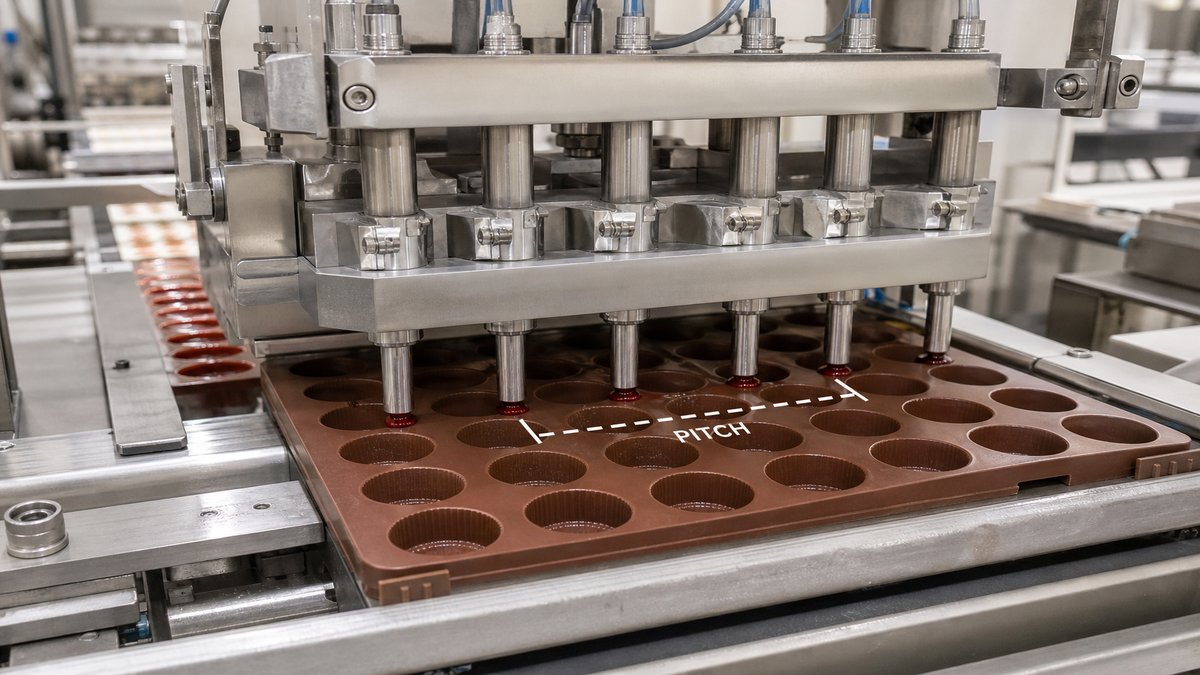
For a custom brand launching a new shape, silicone also makes it easier to validate cavity size, logo depth, spacing and tray format before committing to a more rigid production system. A well-designed silicone tray can be used for manual filling, semi-automatic depositing, or selected automated setups when the tray envelope and support method are designed around the line.
But “silicone” is not enough information for a production specification. The buyer should still define:
- cure chemistry and material grade;
- intended food-contact market and documentation requirement;
- Shore hardness range;
- tray wall and base thickness;
- external tray dimensions;
- cavity volume and target piece weight;
- operating temperature and cleaning method;
- whether the tray sits in a rigid carrier;
- whether filling is manual or by depositor.
For food-contact applications, WYD normally evaluates platinum-cured silicone options and the documentation required for the project. A supplier datasheet, a finished-article test report and a factory certificate are different documents; buyers should specify what they actually need instead of asking only for “FDA silicone.”
When rigid polycarbonate can be the better choice
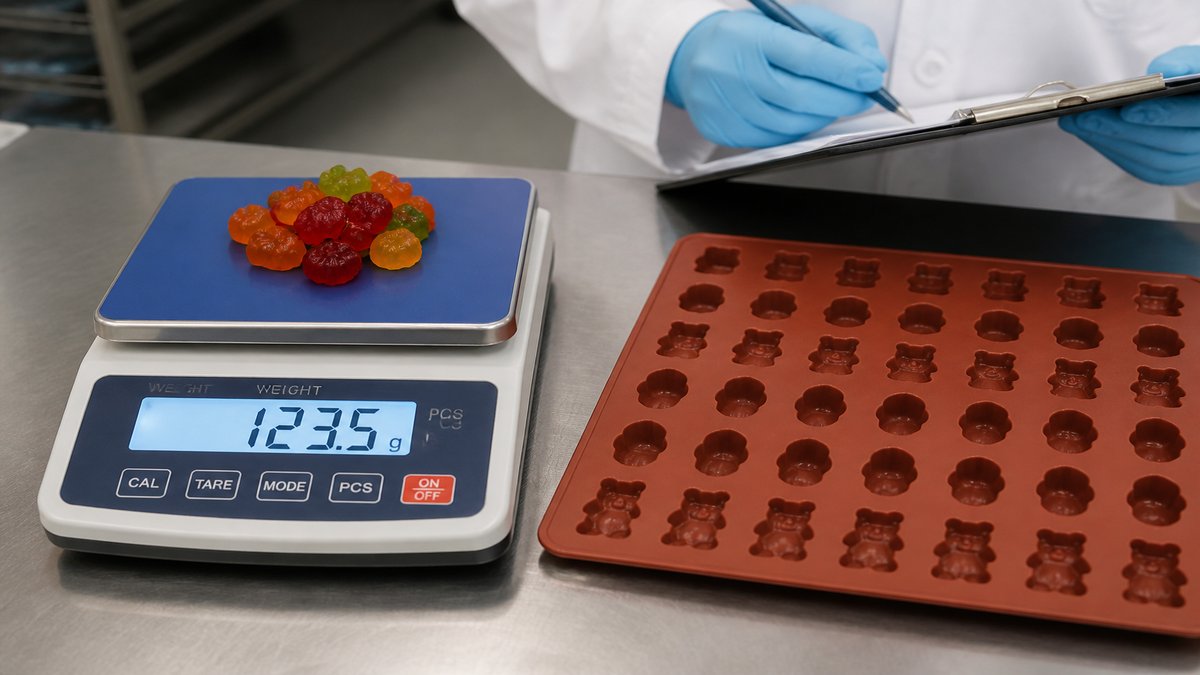
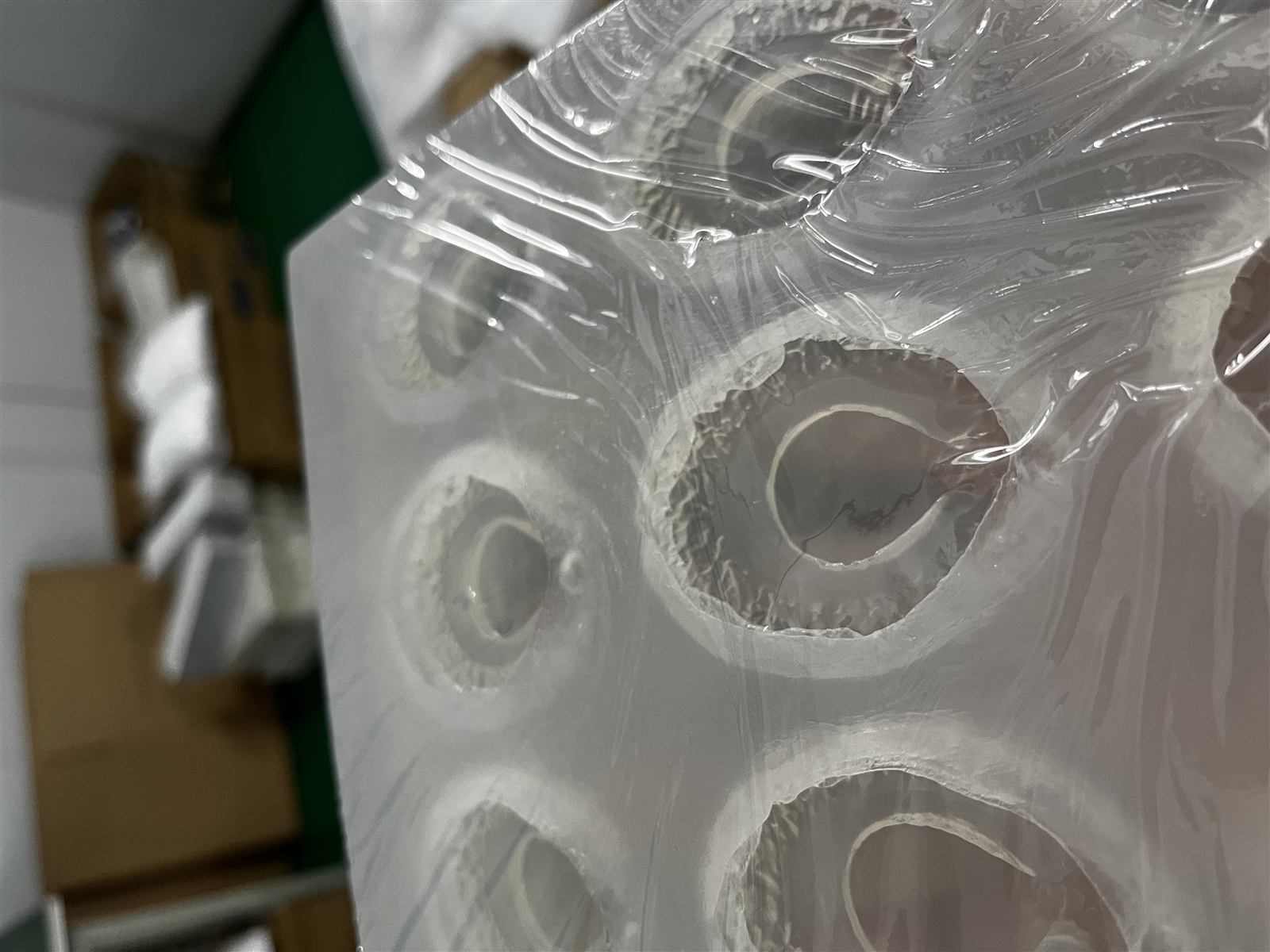
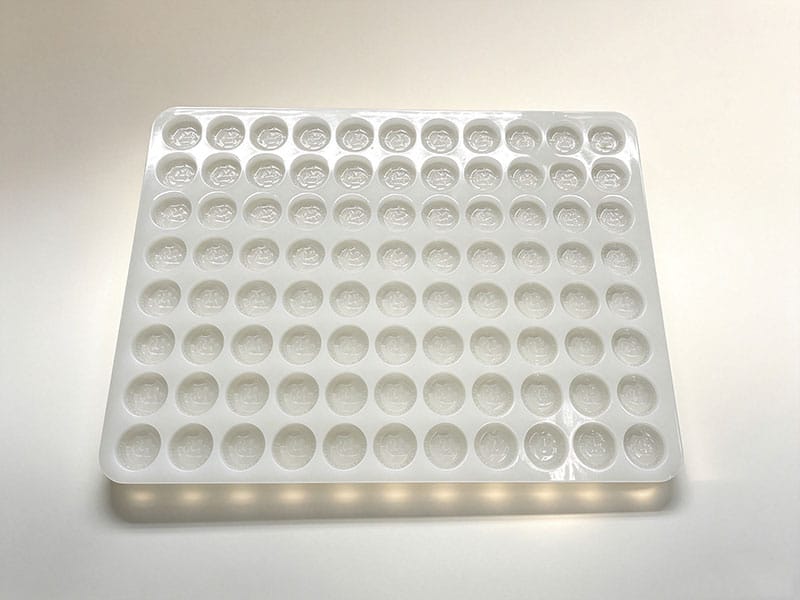
Rigid polycarbonate molds are common where a hard cavity surface, stable tray geometry and glossy finish are priorities. Chocolate production is a familiar example, but rigid systems can also make sense for certain gummy and candy lines.
A rigid tray does not flex to release the product, so cavity geometry must allow the piece to release without excessive mechanical force. Deep undercuts, aggressive texture or internal locking features can make rigid demolding difficult. On the other hand, a rigid tray is easier to locate consistently in some automated systems because the outside dimensions do not flex under handling.
Choose rigid tooling when the production line benefits more from dimensional stability and surface finish than from flexible demolding.
For a deeper side-by-side decision, see our silicone vs polycarbonate gummy mold comparison.
Gelatin vs pectin: the formula changes the mold decision
Mold selection cannot be separated from the gummy formulation.
Gelatin and pectin systems can differ in deposit temperature, set behavior, surface tack and the time at which the piece is strong enough to demold. Two products with the same target weight may therefore need different cavity draft, finish or demold timing.
If a customer tells us only “10 g gummy,” we still need more information before locking the cavity. A better RFQ includes the formula family, approximate density if known, depositing method, expected demolding condition and whether oiling or another release process is used.
The same principle applies to sugar-free, functional, vitamin and nutraceutical gummies. Tooling geometry can control volume; it cannot by itself guarantee final piece weight if density and fill process vary.
Shore hardness is not a complete material specification
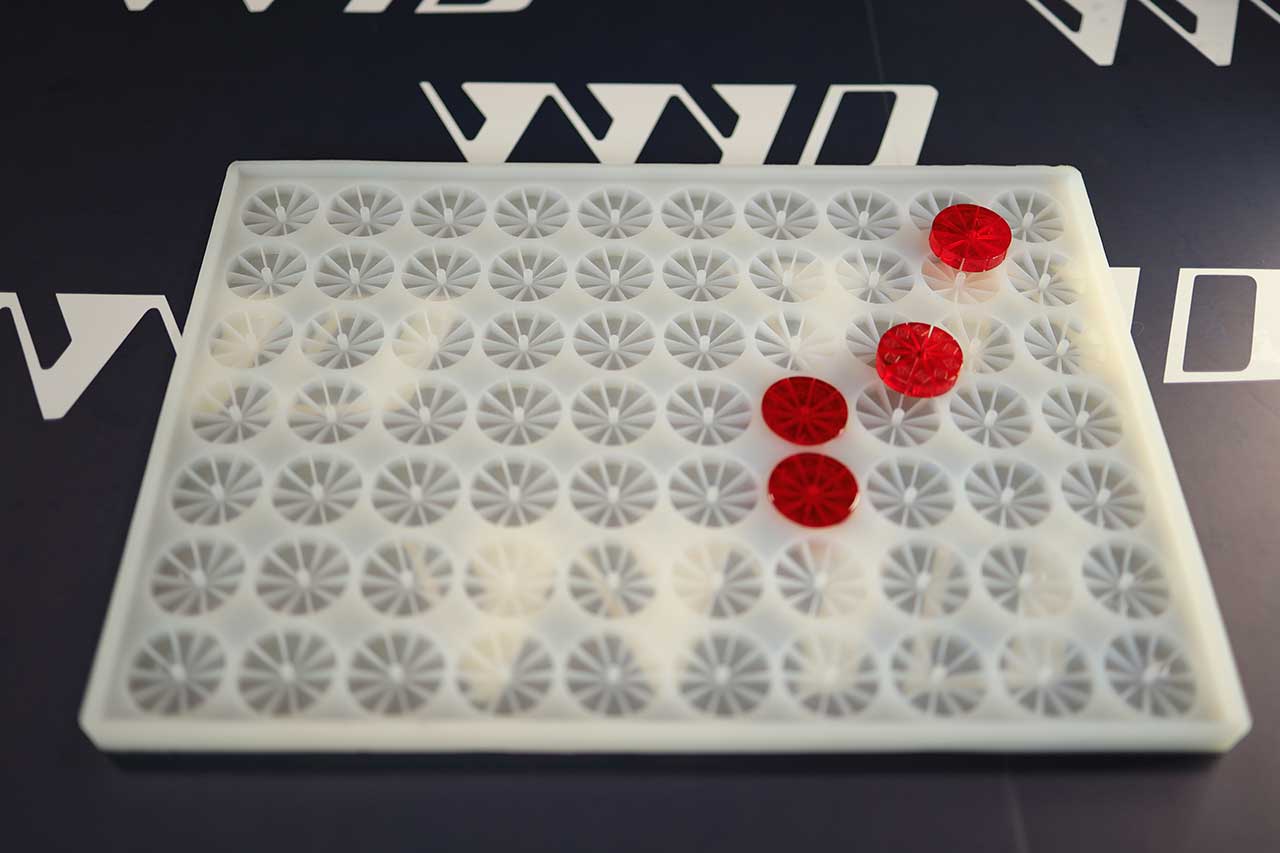
A common buying mistake is to choose silicone only by Shore A hardness. Softer silicone is not automatically easier to demold, and harder silicone is not automatically more durable.
A tray’s behavior comes from the combination of:
- material hardness;
- tear strength;
- cavity wall thickness;
- web thickness between cavities;
- perimeter rim design;
- tray size;
- cavity depth and undercut;
- carrier support during filling and transport.
A 30A tray with thick webs can feel more stable than a 40A tray with an overly thin base. Conversely, a very soft compound can stretch too much during handling even though individual pieces release easily.
This is why we prefer to review hardness together with the actual 3D geometry instead of quoting one Shore value as a universal answer.
Surface finish matters more than many buyers expect
The cavity surface affects the appearance of the finished gummy. A polished master can produce a smoother cavity; a matte or textured master transfers a different look. Logo edges, draft and local texture can also affect how the gummy releases.
If the product requires a premium glossy appearance, test the actual formula against the intended cavity finish. Do not assume a material name alone creates the final surface.
For more detail, see glossy vs matte silicone mold cavity finish.
How to select the mold route for your production line
Before choosing the material, answer these questions:
- What is the target finished gummy weight?
- Do you know the formula density or can you provide a physical sample?
- How many pieces per hour or per batch are required?
- Is filling manual, semi-automatic or depositor-based?
- What tray outside dimensions fit the line?
- Does the product have logos, text, undercuts or deep geometry?
- What finish is required: glossy, satin or textured?
- How will the tray be cooled, stored, washed and dried?
- Which food-contact documentation is required for the destination market?
- Is this a prototype program, a small production run or an established high-volume line?
Those ten answers are more useful than asking a supplier for “the best silicone.”
A practical production example
Consider a buyer developing a branded gummy with a deep 3D icon and a recessed logo. The first priority is usually reliable release without tearing the gummy or distorting the logo. Flexible platinum-cured silicone is a logical development route because the cavity can flex during release.
If the same product later moves to a highly automated line, the engineering question changes. The team may need to review tray rigidity, indexing, robotic handling and whether the geometry can be converted to a rigid tool. The original “best material” can change because the process has changed.
That is normal product development—not a tooling failure.
FAQ
Is food-grade platinum silicone always the best material for gummy molds?
No. It is a strong option for flexible custom molds, but rigid systems can be better for some glossy or automated applications. The correct route depends on product geometry and line requirements.
Can one silicone hardness work for every gummy tray?
No. Hardness must be considered together with tray size, wall thickness, cavity depth, tear strength and support method.
Can cavity volume guarantee gummy weight?
No. Cavity volume is one input. Final weight also depends on formulation density, filling accuracy, shrinkage or moisture loss, and process control.
Do pectin and gelatin gummies need different molds?
Not necessarily, but they can have different release and setting behavior. It is safer to validate the intended formula and demolding process before mass production.
What should I send for a custom gummy mold quotation?
Send the 2D/3D design or reference image, target piece weight, formula family, expected quantity, tray size limit, filling method and required documentation. If you do not have 3D files, WYD can review the concept and develop the geometry.
Need help choosing the material route?
WYD develops custom silicone gummy molds for brands and manufacturers using prototype-first validation. For current custom-mold programs, MOQ can start from 20 pieces. Send your drawing, target gummy weight, tray size and production method through our custom gummy mold page or contact WYD for a DFM review.
Ready to order custom silicone molds?
Send your drawing, sample or project requirements for DFM and quotation.