
Silicone Rubber Compounding: Step 1 of Making Custom Silicone Products
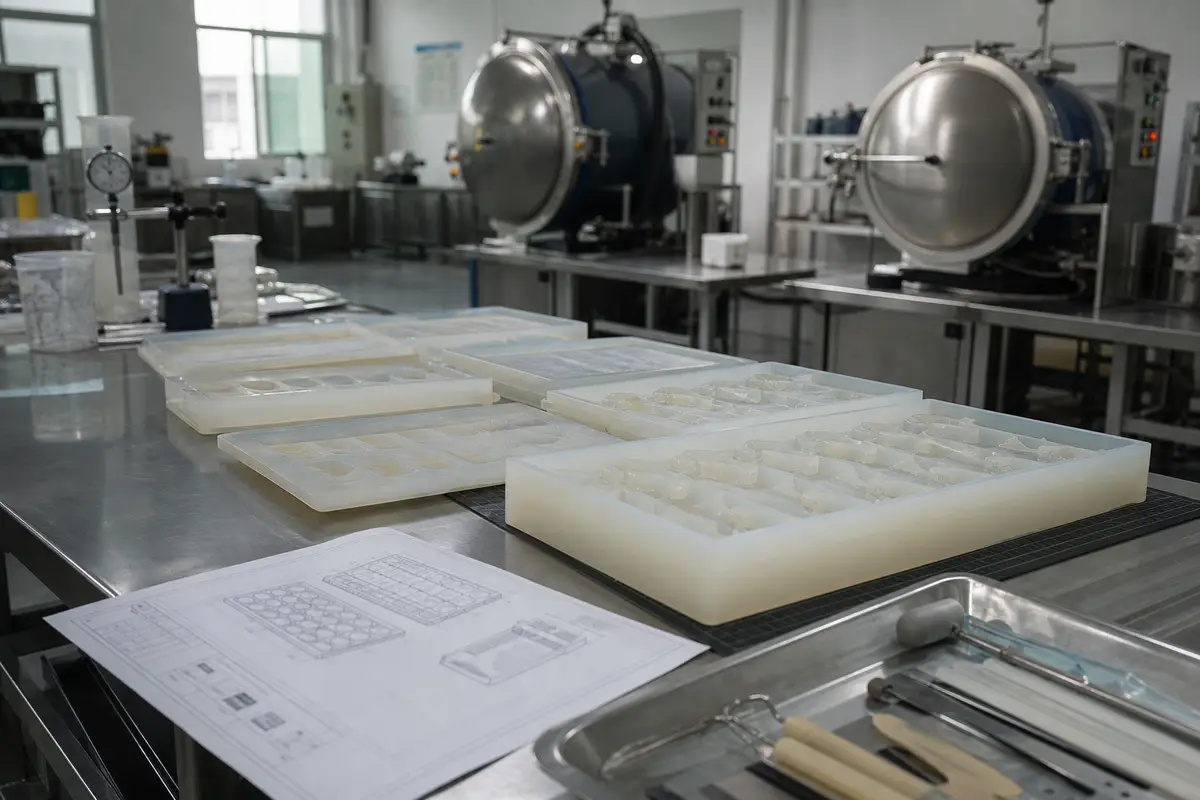
HCR compounding on the mill before the press: color, Shore A, cure system, food-contact cleanliness, and what to ask before a production mix.
On this page
Buyers picture the press closing. Color streaks, wrong Shore, and dirty food-contact lots are often decided earlier, on the mill. That step is rubber compounding - mixing solid silicone (HCR/HTV) before it is blanked and pressed.
What is rubber compounding?
You blend base gum with filler, color, and a cure system until it is a uniform sheet, ready to cut into preforms. This is the HCR/HTV path used for many compression trays, keypads, gaskets, and mats.
LSR and RTV arrive as liquids. They are not mill compounds. Do not quote them as the same object. Route compare: compression vs LSR.
What goes into a silicone compound?
- Base gum - the polymer.
- Silica filler - tear and strength.
- Color - pigment or masterbatch, mixed through, not painted on.
- Cure - peroxide or platinum, depending on the grade. It must not kick on the mill.
- Other additives only when the job needs them.
Food-contact SKUs need a grade and additives that match that use. We do not call the plant FDA-approved.
How the mixing is done
- Work the gum on a two-roll mill or internal mixer until it is pliable.
- Add filler and color until there are no streaks.
- Add cure late, at a temperature that does not start crosslink.
- Refine, sheet, cut blanks.
- Rest and inspect before the press.
Why compounding matters to your product
Color
Uneven mix shows as patches. Brand colors and set pieces fail first.
Shore A
A soft gummy tray, a firm keypad, and a gasket are different recipes. Shore is measured on the cured part, not guessed from the mill.
Demold and tear
Filler and cure dispersion change release and how the part survives flex.
Cleanliness
A food-contact article cannot be cleaner than the compound. Equipment, grade control, and no cross-color dust are part of the job.
What to ask your manufacturer
- Which grade and cure system for this order?
- How is color matched lot to lot?
- What Shore A window is on the quote?
- Are food-contact reports available for that grade?
- Is post-cure in the process?
After compounding
Preforms go into a heated steel tool. Heat and pressure cure the shape. Then trim, inspect, often post-cure, then pack. Prototype after CAD lock is commonly 3-5 business days. Custom color can add mill time - confirm in the quote.
Send Shore target, color, use, and qty to /contact/. Soft-tray MOQ is often 20 per design when the part is a tray, not a steel keypad tool.
FAQ
Pantone match? Usually possible on HCR. Approve a plaque before bulk mix.
What Shore should I pick? Send the application. We will put a range on the prototype, not a universal number.
Does compounding add days? Custom color and hardness can. Production days after approval are not a site-wide 2-3 day promise.
Ready to order custom silicone molds?
Send your drawing, sample or project requirements for DFM and quotation.