
Silicone Insert Molding Position and Retention
Control plastic or metal inserts during silicone molding through datums, fixtures, mechanical retention, shutoff and functional pull/peel testing.
On this page
An overmolded part can have strong adhesion and still fail if the insert is in the wrong place.
Insert molding therefore requires two independent controls:
- retain the silicone on the insert
- hold the insert in the correct position during molding
Define Datums

The insert drawing should identify the features that locate it in the tool.
Possible datums include:
- holes
- bosses
- edges
- pins
- machined faces
The locating system should control the dimensions that matter in the final assembly.
Insert Movement
During molding, pressure and flow can move an unsupported insert.
Possible results:
- uneven silicone thickness
- blocked hole/port
- flash
- cosmetic mismatch
- assembly failure
Tooling should hold the insert securely without damaging it.
Shutoff Around the Insert
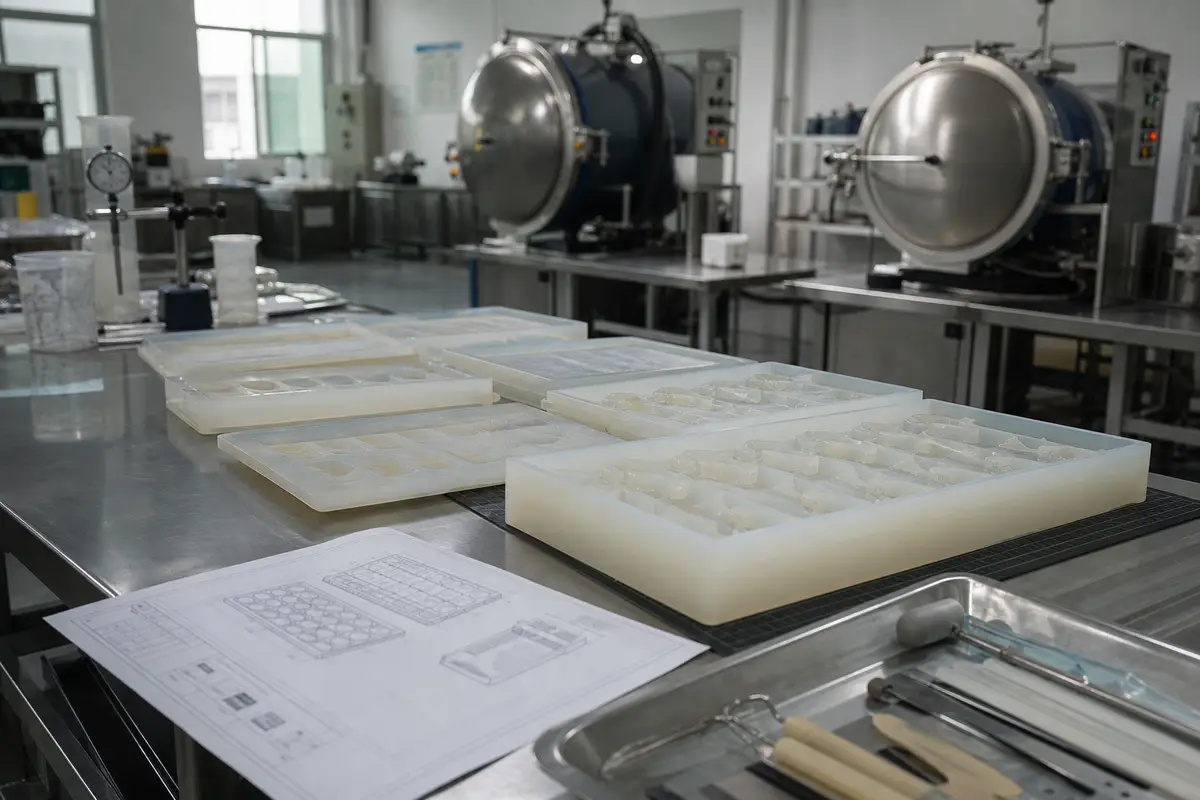
Where silicone meets a rigid substrate, the tool needs controlled shutoff.
Poor shutoff can create:
- flash on metal/plastic
- silicone leakage into threads/holes
- inconsistent edge line
Mechanical Retention
Useful retention features may include:
- through-holes
- grooves
- undercuts
- wraparound edges
- perforations
These can support attachment even where chemical bonding is limited.
Chemical Bonding
If the design relies on adhesion, validate:
- exact substrate
- surface preparation
- primer/treatment
- silicone chemistry
- molding process
Do not assume all plastic types bond equally.
Positional Tolerance Stack
The final insert location depends on:
- insert tolerance
- fixture/tool tolerance
- silicone shrinkage
- mold process
Critical insert position should be inspected from defined datums.
Prototype Test
Check:
- insert location
- interface flash
- pull/peel/torque as applicable
- assembly
- repeated flex
- cosmetic boundary
Insert Preparation
Rigid inserts should arrive in a controlled condition.
Depending on the project:
- clean surface
- no oil
- correct coating/plating
- no burrs
- dimensional conformity
can all affect shutoff, bonding and fit.
Thermal Effects
Metal and plastic inserts can respond differently to molding temperature.
Review whether:
- plastic can distort
- coating can degrade
- insert expands enough to affect fit
Multiple Inserts
Parts with more than one insert create a positional tolerance stack.
A fixture should control the relationship between inserts, not only each insert independently.
Traceability
For critical assemblies, identify:
- insert lot
- silicone lot
- tool revision
- bonding/surface process
- inspection result
This helps isolate whether a future failure comes from the rigid insert, silicone process or interface.
Incoming Insert Variation
An insert can be within its own drawing tolerance and still create an overmold problem if the mating shutoff dimension is at an unfavorable limit. For tight interfaces, review worst-case insert dimensions and the mold shutoff together.
If the buyer supplies inserts, define incoming inspection responsibility and how nonconforming inserts are handled before molding.
Related WYD Pages
Final Recommendation
Treat insert location and retention as separate engineering requirements. A part can pass one and fail the other.
Ready to order custom silicone molds?
Send your drawing, sample or project requirements for DFM and quotation.