
Are Silicone Molds Good for Chocolate? When to Use Silicone vs Polycarbonate
See when silicone molds work well for chocolate bars, deep shapes and custom logos—and when rigid polycarbonate is better for gloss and production handling.
On this page
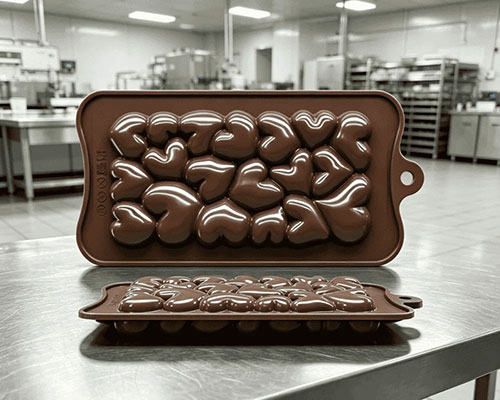
Silicone molds can be very good for chocolate—but they are not automatically the best choice for every chocolatier or production line.
Flexible silicone is excellent for custom shapes, deep relief, complex logos and products that benefit from peeling the mold away during release. Rigid polycarbonate is often preferred when maximum gloss, sharp rigid cavities and high-speed handling are the main priorities.
The right mold depends on the chocolate, product geometry and production method.
When silicone is a strong choice
Silicone works particularly well for:
- custom branded chocolate shapes;
- deep 3D designs;
- novelty pieces;
- prototypes and seasonal launches;
- geometry that is difficult to release from a rigid cavity;
- low-to-medium quantity product development;
- applications where the mold must flex during demolding.
A flexible cavity can release features that would otherwise need more draft or a multi-part rigid tool.
When polycarbonate is stronger
Rigid polycarbonate is commonly used for professional chocolate bars and bonbons because a polished rigid cavity can support high gloss and consistent geometry.
It is often the better fit when:
- the product requires a highly polished appearance;
- the cavity has a simple rigid release path;
- automated handling requires a stiff tray;
- large production volume justifies rigid tooling;
- the process is already built around standard polycarbonate mold formats.
Choosing silicone only because it is easier to demold can be a mistake if the buyer’s first priority is a mirror-like finish and automated indexing.
Surface finish and tempering work together
A polished mold cannot compensate for poorly tempered chocolate, and perfect tempering cannot fully hide a damaged cavity.
Final appearance depends on:
- chocolate formulation;
- tempering profile;
- cavity finish;
- cooling conditions;
- release timing;
- surface cleanliness.
For premium products, validate the real chocolate in the real mold before approving production.
Custom logos and text
Silicone reproduces detail well, which makes it useful for branded chocolate bars and promotional shapes. The design still needs to respect the scale of the chocolate.
Very thin text strokes can break or fill inconsistently. Deep recessed lettering can trap the part. A good DFM review checks:
- line width;
- logo depth;
- draft on vertical features;
- corner radii;
- overall chocolate thickness;
- release direction.
The cleanest vector artwork is not automatically the most manufacturable edible logo.
Deep 3D shapes
This is where silicone often has a practical advantage. The mold can flex around the product and reduce the need for complex rigid ejection.
For full 3D chocolate pieces, the project may use:
- one-piece open molds;
- two-part silicone molds;
- multi-part molds for complex geometry;
- support shells for large flexible molds.
The correct structure depends on whether the chocolate is hollow, solid and how the seam line should appear.
Food-contact material and documentation
For a reusable chocolate mold, specify the exact material/document requirement for the destination market. Platinum-cured silicone is commonly used for food-contact molds, but “food grade” should not be treated as a complete specification.
The buyer may need:
- supplier material identification;
- applicable FDA-related or LFGB test documentation;
- finished-article test report;
- batch or production traceability.
Do not write “FDA approved factory” on the purchase order. Ask for the document that applies to the material/article.
Heat is usually not the limiting issue for chocolate molds
Chocolate processing temperatures are generally far below the thermal capability of many silicone compounds. More practical concerns are tray stiffness, cavity finish, cleaning and release.
A very soft large tray can flex while filled, causing chocolate thickness to vary if it is moved without support. A rigid carrier or reinforced tray structure may be more important than changing the silicone grade.
Cleaning silicone chocolate molds
Protect the cavity surface. Avoid sharp scraping, abrasive pads and uncontrolled folding.
A production cleaning method should define:
- detergent;
- wash temperature;
- brush or no-brush rule;
- drying method;
- stacking/storage;
- inspection for cuts or residue.
For high-gloss cavities, even small scratches can become visible in the finished chocolate.
Silicone vs polycarbonate: procurement decision
Choose silicone when the project needs flexibility, complex geometry and lower-risk custom development.
Choose polycarbonate when the project needs rigid handling and maximum polished-cavity behavior.
For a product line with several SKUs, it can be reasonable to use both: silicone for limited-edition 3D shapes and polycarbonate for standardized high-volume bars.
What WYD needs for a custom chocolate mold
Send:
- 2D/3D design or artwork;
- desired piece weight/dimensions;
- solid or hollow product;
- desired finish;
- cavity count;
- tray size limit;
- manual vs automated process;
- required food-contact documents;
- prototype and production quantities.
Current custom silicone mold MOQ can start from 20 pieces. For relatively simple designs, 3D modeling commonly starts around USD 50. Actual tooling and production price depends on cavity count, mold size, geometry and manufacturing route.
FAQ
Are silicone chocolate molds professional quality?
They can be. The correct question is whether silicone fits the product geometry, finish and production process. Many professional custom shapes benefit from flexible release.
Why do chocolatiers use polycarbonate molds?
Rigid polished polycarbonate supports stable handling and high-gloss cavities, which is valuable for bars and bonbons with simple release geometry.
Can silicone make glossy chocolate?
It can produce a smooth finish when the cavity and chocolate process are controlled, but rigid polished polycarbonate often has an advantage when maximum gloss is the main requirement.
Is platinum silicone required for chocolate molds?
Select a silicone grade documented for the intended food-contact use and market. Platinum-cured systems are commonly used, but the exact material/document package should be specified.
Develop a custom chocolate mold
Send your design and production requirements through WYD custom food silicone molds or contact us. We will review whether silicone is the right route instead of forcing every chocolate project into one mold material.
Ready to order custom silicone molds?
Send your drawing, sample or project requirements for DFM and quotation.