
Silicone Tray Full-Load Sag Check Before You Lock Cavity Count
How to check if a multi-cavity silicone tray will sag when full before locking cavity count - span, support, fill weight, and a practical checklist.
On this page
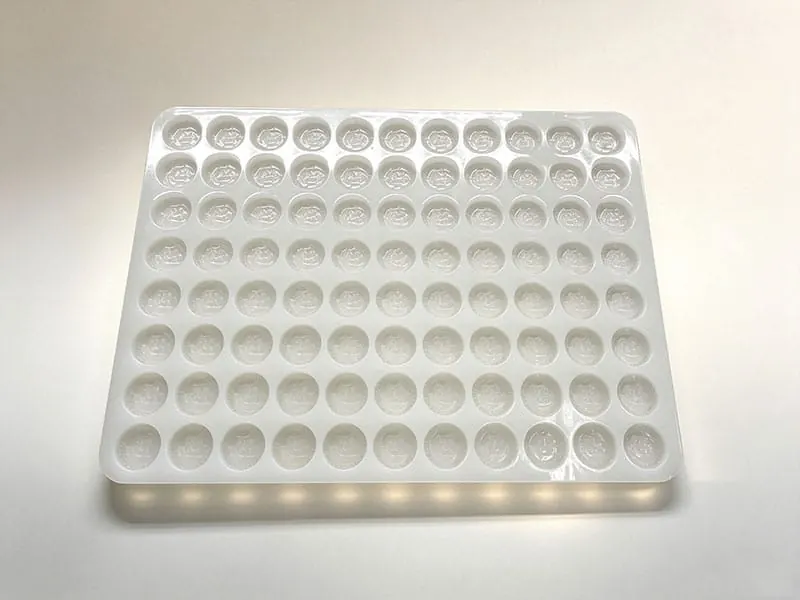
How do you check if a multi-cavity silicone tray will sag when full before you lock cavity count? Treat sag as a filled-tray mechanics problem - span, wall and rib layout, support points, and fill weight. Locking cavity count from empty-tray photos alone is how buyers discover mid-span droop on the first production fill. Route context: capabilities. Related filled-tray checks: first-bake edge vs center, ice tray filled handling.
Showcase Shorts are process context - not a measured sag certificate for your tray geometry or fill weight.
What full-load sag means
Sag means the tray deflects under filled cavities enough to pool liquid toward the center, change piece weight between edge and center, make rack or depositor transfer unreliable, or stress parting edges. Empty hardness feel is not a substitute.
What to specify before cavity-count lock
- Outer envelope and free span - longest unsupported span between rack lips or supports.
- Support plan - full perimeter, two rails, corner pads; mark on a sketch.
- Fill assumption - grams per cavity × count ≈ filled mass.
- Wall / floor / rib intent - minimum floor thickness; cross-ribs under the cavity field.
- Hardness band - softer is not always better for large spans.
- Pass/fail - max mid-span droop under a stated fill and support condition on samples.
Practical sample check
Prototypes often about 3-5 business days after CAD approval for a prototype (reply typically within 12 hours; CAD / DFM 1-3 business days; small batch typically 2-3 business days after sample approval; standard production typically 7-10 business days after approval; large or complex jobs confirmed by project; shipping separate) when suitable. On samples: same support as production → fill to target weight → observe mid-span and edge cavities → photograph side profile with a straightedge → log edge vs center if grams matter.
If sag fails: thicker floors, ribs, shorter span, harder Shore, or external support - not "just add more cavities." Include a rigid carrier in the check if production uses one.
How cavity count and sag interact
| Lever | Effect on sag risk |
|---|---|
| More cavities on same envelope | Higher filled mass; often more droop |
| Longer unsupported span | Higher mid-span deflection |
| Thinner floor / no ribs | Less resistance to bow |
| Softer Shore | More flex under the same load |
| Better rack support | Can allow softer or thinner designs |
Cavity count is commercial. Sag is physics. Lock them together after a filled check.
Commercial notes on the quote
Soft-mold floor about 20 molds per approved design - commercial floor, not a process switch. Separate tooling/sample line items. State which support and fill assumption sample approval covers. Food-contact docs are a separate package if food-use - docs ≠ sag proof. See also docs vs temperature.
What to send
- STEP/2D or photos; cavity map and target grams per cavity.
- Rack / shelf / depositor support sketch.
- Shore band and rib/floor preferences.
- Pass/fail sag definition for samples.
- Prototype and first-order quantities; destination.
/contact/ · info@wydsilicone.com
FAQ
Lock cavity count from empty-tray photos? Risky. Run a filled support check first.
MOQ 20 a reason to change process? No. Confirm route on the quote.
DFM fix sag for free? DFM advice is typically free; CAD changes are paid and complexity-dependent.
Ready to order custom silicone molds?
Send your drawing, sample or project requirements for DFM and quotation.