
How to Prepare a Custom Silicone Mold RFQ
Prepare a useful custom silicone mold RFQ with design files, dimensions, casting/use conditions, cavity count, quantity, documentation, prototype goals and shipping information.
On this page
A good RFQ does not need to answer every engineering question.
It needs to separate:
- what is already fixed
- what is still open
- what the mold must do
- what the supplier needs to quote without inventing assumptions.
"Please quote this mold" with one image usually creates more questions than a useful price.
A structured RFQ helps the supplier choose the right mold route, identify missing information and separate development cost from repeat production.
1. Send the Best Design Reference You Have
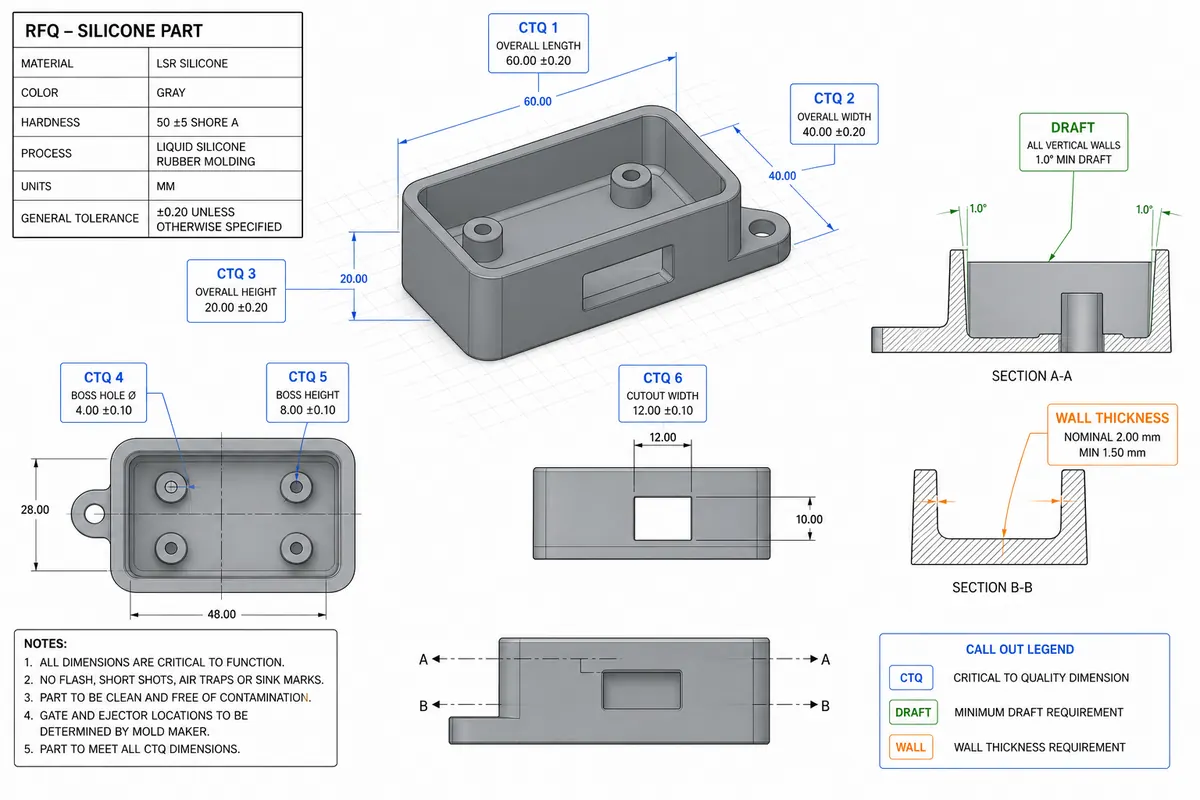
Preferred inputs can include:
- STEP/STP
- STL
- 2D drawing
- physical sample
- measured photos
- artwork
- sketch
- reference images.
You do not need a finished 3D file to start.
If you send photos, include:
- front/side/back
- scale or known dimension
- close-ups
- overall dimensions
- flat-back/full-3D note.
If the geometry must be developed from images, state that clearly so design work is not hidden inside the tooling quote.
2. Say What You Need the Supplier to Deliver
This is critical.
Are you buying:
- an RTV casting mold
- a compression-molded silicone tray
- a finished silicone product
- production tooling
- a prototype only
- prototype + repeat molds?
Do not assume the supplier interprets "custom mold" the same way you do.
A useful RFQ says:
"We need 20 reusable silicone casting molds for this plaster figure."
or:
"We need a production silicone tray with 40 gummy cavities compatible with our depositor."
The object being purchased defines the quote.
3. Describe What Goes Into or Contacts the Mold
For casting molds, identify:
- resin
- plaster
- wax
- soap
- gummy
- chocolate
- ice
- batter
- other material.
For a finished silicone part, describe:
- mating component
- fluids/chemicals
- food/skin contact
- environment.
The supplier uses this to review:
- material
- release
- support
- temperature
- documentation
- process.
4. Give Finished Dimensions and Functional Targets
Include:
- overall part/casting size
- critical dimensions
- target piece weight/volume where relevant
- logo or surface detail
- fit/sealing requirement
- flat-back/full-3D
- undercuts.
If a dimension is approximate, mark it approximate.
Do not turn an early estimate into a fake tolerance.
If the finished product must fit packaging, a rack, an oven, a freezer, a machine or another part, send those interface dimensions too.
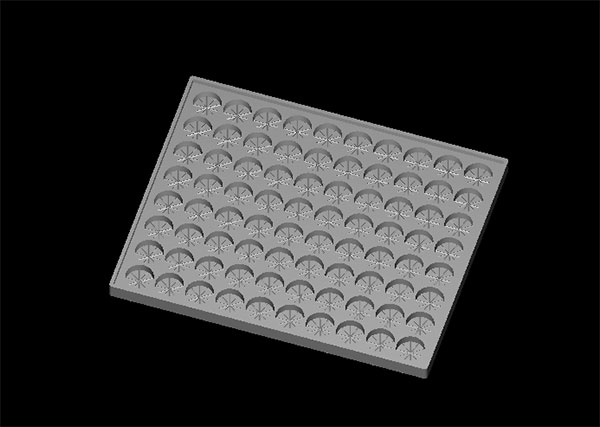
5. Define Cavity Count and Production Layout
Tell the supplier:
- number of cavities
- rows/columns if fixed
- tray-size limit
- spacing/pitch if equipment-controlled
- first-cavity datum if relevant
- support frame or pan.
If cavity count is not fixed, send:
- daily/batch target
- available tray envelope
- filling method.
The supplier can then propose a layout rather than guessing.
6. Describe the Real Use Condition
Provide any relevant:
- fill/pour temperature
- oven temperature/time
- freezer condition
- curing/exotherm
- cleaning
- chemicals
- repeated flex/load
- demolding method.
If unknown, say unknown.
Hidden assumptions are worse than missing values.
7. State What the Prototype Must Prove
Examples:
- target gummy weight
- wax snap behavior
- resin release
- plaster detail survival
- soap logo release
- baking tray loaded stability
- lid fit
- overmold pull/torque.
This helps define:
- prototype route
- number of variants
- test setup
- acceptance criteria.
A prototype without an acceptance question can become an expensive visual sample.
8. Give Quantity in Stages
Send:
- prototype quantity
- first production quantity
- repeat/annual forecast.
Why?
Tooling/process choices can change when the customer needs:
- one development mold
- 20 repeat molds
- hundreds of trays
- large OEM production.
Do not request only "best unit price" without volume context.
9. Identify Material or Documentation Requirements
If the buyer already has a requirement, state it:
- silicone type/grade
- Shore target
- food-contact standard
- customer specification
- healthcare material requirement
- color
- post-cure or cleaning requirement.
If no material is fixed, describe the application instead.
Do not guess "FDA silicone" when the real need is a market-specific food-contact document for a defined use.
10. Provide Shipping and Commercial Information
For freight/quote scope, include:
- destination country
- city/postcode where useful
- preferred Incoterm if known
- prototype vs production shipment
- target date.
The final freight quote depends on:
- packed size
- weight
- cartons
- transport mode.
Do not compare an EXW quote with a DDP quote as if they are identical.
11. Ask the Supplier to Separate Quote Components
A clear quotation can separate:
- engineering/CAD
- master pattern
- prototype
- production tooling
- repeat mold/product price
- testing
- packaging
- freight.
This makes supplier comparison more useful.
If the project changes, you can see which cost changes instead of restarting from one unexplained total.
Copyable RFQ Template
Project name:
[ ] Not sure - please recommend
CAD / drawing / physical sample / photos / artwork
Logo/detail:
Demolding or assembly method:
Tray size / machine / rack constraints:
3.
Target market:
Repeat / annual forecast:
Target date:
```
Do not fill an unknown field with a guess. Mark it open.
Example of a Useful First RFQ
We need a 12-cavity soap mold for a finished bar approximately 3.5 × 2.5 × 1.25 in. The soap process is cold-process. We want a soft reusable mold but need support when fully filled. We do not have final CAD; artwork and bar dimensions are attached. Please review the outside tray size, approximate mold weight, prototype route and quotation for 20 molds.
This is useful because the supplier knows:
- deliverable
- process
- bar size
- cavity count
- support problem
- design status
- requested quantity.
The engineering details can then be resolved rather than guessed.
Before You Send
Check:
- Is the correct file attached?
- Are units clear?
- Is the quantity defined?
- Did you identify the casting/application material?
- Did you mark approximate values?
- Did you state the prototype goal?
- Did you include destination?
- Did you name required documents?
Then send the package.
For WYD-specific project review, use Contact or Custom Silicone Mold Manufacturer.
For sample planning, see Silicone Prototyping.
Ready to order custom silicone molds?
Send your drawing, sample or project requirements for DFM and quotation.