
How to Choose Silicone Hardness for a Custom Product
Choose silicone hardness by function, wall thickness, geometry, load, return behavior and demolding—not Shore A alone. Practical OEM design guide.

On this page
Shore A is one of the most quoted silicone numbers and one of the most misunderstood.
A buyer may ask for “very soft 20A silicone” because the product should feel flexible, or “50A because it must hold its shape.” Those requests are useful starting points, but hardness alone does not determine how the finished part behaves.
The real design question is:
What should the part do under load, during assembly, during stretching and after release?
Hardness vs Stiffness
Two parts molded from the same silicone hardness can feel completely different.
Stiffness also depends on:
- wall thickness
- width/span
- ribs
- hollow sections
- cross-section
- preload
- insert structure
- part length
A 40A thick block can feel very rigid. A thin 40A membrane can feel extremely flexible.
So if a tray sags, the answer may be better geometry rather than simply moving to a harder compound.
Soft Products That Must Still Hold Shape
This is common in:
- baby sensory products
- bracelets
- grips
- collapsible products
- soft covers
- flexible straps
A recent type of buyer question is: “Can the product be soft enough for a baby to grab and chew, but not snap back quickly when stretched?”
That is not solved by Shore A alone.
Return behavior also depends on:
- part cross-section
- stretch ratio
- material hysteresis
- geometry
- internal features
- length
- how the load is applied
If “slow return” is a functional requirement, it should be tested on a prototype. Conventional elastic silicone naturally stores energy and recovers; a deliberately controlled return may require geometry or a different mechanism rather than simply softer silicone.
Mold Hardness for Demolding

For reusable casting molds, lower hardness can help a mold flex around undercuts. But very soft material can also:
- distort under casting weight
- stretch excessively at thin sections
- make multi-part alignment less stable
- increase handling difficulty
The selected hardness should be paired with adequate wall thickness and, for large molds, a support shell when needed.
Gaskets and Seals
For seals, hardness influences compression force, but the system also depends on:
- groove geometry
- squeeze
- mating-part tolerance
- media
- pressure
- temperature
- compression set
A seal should not be specified by Shore A alone.
Food Trays and Baking Molds
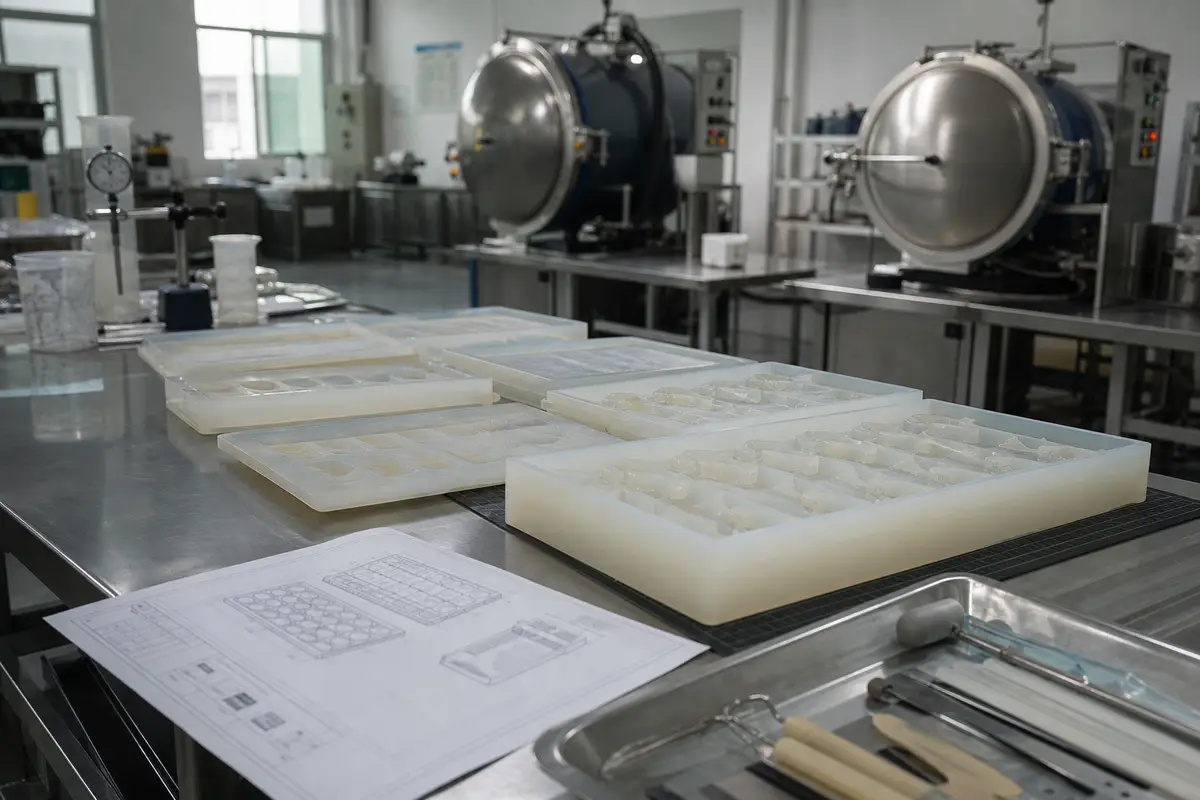
A food tray must balance flexible release with loaded stability.
Review:
- full tray span
- cavity depth
- flange
- wall thickness
- whether the tray sits in a rigid rack/pan
- whether it is carried while full
A softer silicone may release well but become awkward to handle. A harder silicone may feel stable but require more force during demolding.
How to Specify Hardness Better
Instead of writing:
> “Silicone: 40A.”
Write:
> “Target 40A starting point; final sample must hold the loaded tray without excessive sag and allow manual demolding without tearing.”
Or:
> “Soft-touch wearable component; must recover after stretch without striking the user.”
This tells the factory what the number is trying to achieve.
Prototype Plan
For hardness-sensitive projects, compare samples by function.
Measure or observe:
- handling stiffness
- loaded deflection
- pull force
- seal compression
- insertion/removal
- demolding force
- recovery
- user feel
- tear at critical features
The prototype should be tested in the real assembly or use condition.
Related Pages
FAQ
Is 30A twice as soft as 60A?
No. Shore A is not a simple linear “twice as soft” scale for product feel.
What hardness is best for gummy molds?
It depends on tray size, wall thickness, cavity geometry and handling. Do not select the compound from hardness alone.
Can a soft silicone product return slowly after stretching?
Standard silicone tends to recover elastically. If controlled return is a key requirement, prototype the geometry and mechanism rather than relying only on Shore A.
Final Recommendation
Specify the function first and hardness second. The best silicone hardness is the one that works with the geometry to meet the actual product requirement.
Ready to order custom silicone molds?
Send your drawing, sample or project requirements for DFM and quotation.