
How Many Cavities Does Your Gummy Mold Need?
Calculate gummy mold cavity count from pieces per hour, cycle time, tray rotation, depositor pitch and downtime instead of copying a dense tray layout.
On this page
The right gummy mold cavity count is not “as many as can fit on the tray.” It is the number that supports the required output while keeping filling, cooling, handling and demolding practical.
A 100-cavity tray is not automatically more productive than a 60-cavity tray. If it is too large for the depositor, too flexible to carry safely or too slow to demold, the higher cavity count can reduce real throughput.
Step 1: start with required pieces per hour
Convert the production target into pieces.
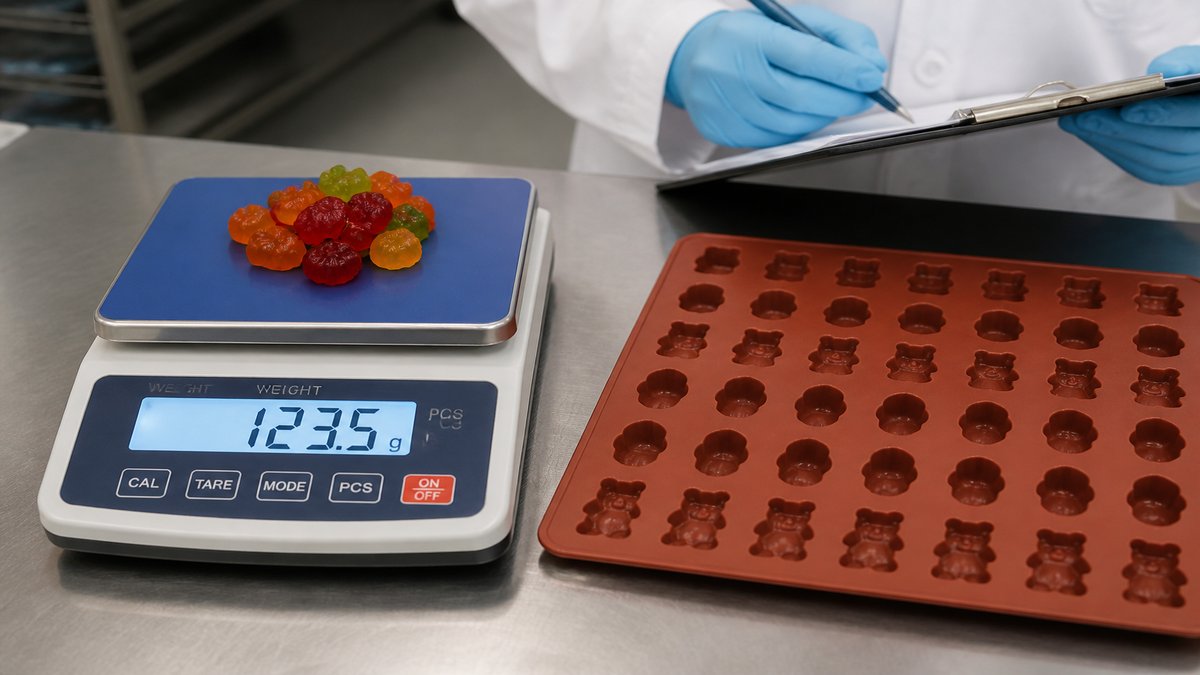
If the customer wants 12,000 gummies per 8-hour shift:
12,000 ÷ 8 = 1,500 pieces per hour
That is the output requirement before downtime, cleaning or rejects.
If the product target is given in kilograms, divide the batch mass by the target piece weight first. Use the real finished weight, not an assumed cavity volume.
Step 2: define the effective mold cycle
For gummies, the “cycle” is not always a machine cycle. It can include:
- filling;
- leveling or transfer;
- setting/cooling;
- demolding;
- cleaning or re-oiling;
- returning the tray to the filling station.
If trays rotate through racks, multiple molds are active at the same time. The correct calculation is therefore based on tray rotation, not just the time an operator spends filling one tray.
Step 3: estimate active cavities required
A simplified model is:
Required cavities in active rotation = pieces per hour × average residence time in hours ÷ expected successful releases per cavity per rotation
Then convert that total into a practical number of trays.
Example: if the line needs 1,500 pieces per hour and product remains in the tray for roughly 30 minutes, at least 750 cavities are occupied at any moment before adding handling allowance. That could be ten 75-cavity trays, fifteen 50-cavity trays, or another layout that fits the equipment.
The layout decision comes after the process decision.
Step 4: check tray size and stiffness
A cavity count that fits mathematically may not fit physically.
Check:
- maximum tray width/length;
- rack size;
- carrier plate size;
- operator reach and lifting weight;
- base thickness;
- web thickness between cavities;
- perimeter rim.
Large soft trays may need a rigid carrier. Increasing Shore hardness is not always the best way to stop sagging.
Step 5: match depositor pitch
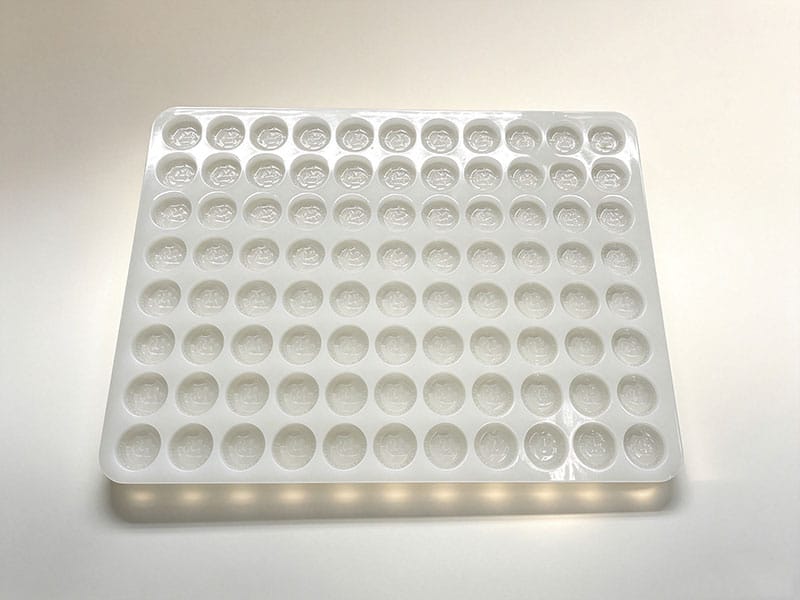
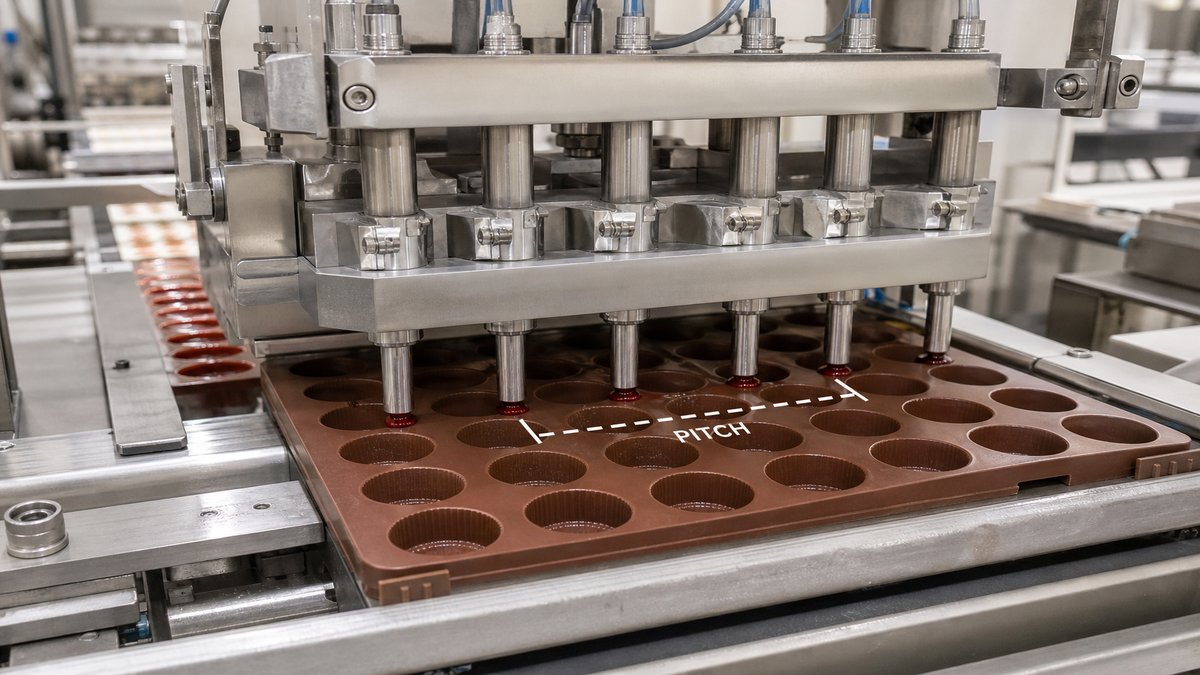
For automatic or semi-automatic depositing, nozzle spacing can determine cavity pitch.
If the depositor fills multiple cavities simultaneously, send the nozzle-center dimensions and index pattern before the mold is designed. A beautiful dense layout is useless if nozzles must fill cavities one at a time because the pitch is wrong.
Also consider whether the line fills one row, multiple rows or the complete tray at once.
Step 6: account for downtime and non-productive trays
Real production has interruptions. Trays may be:
- in washing;
- drying;
- waiting for demolding;
- being inspected;
- temporarily removed due to damage.
Do not size the tooling set to exactly 100% theoretical utilization. Production planning should include a realistic spare/rotation allowance based on the plant’s process.
Step 7: cavity spacing affects both density and release
Packing cavities tightly increases count but reduces silicone web width. Thin webs can stretch during demolding and make the tray less stable.
Spacing also affects:
- hand access;
- product overflow cleanup;
- cutting or trimming if required;
- tray rigidity;
- cooling behavior.
The best layout balances capacity with handling.
A practical example
Suppose a buyer needs 20,000 gummies per day and runs one 8-hour shift. That equals 2,500 pieces per hour.
The formula requires around 40 minutes before reliable demolding. The plant uses a depositor that is comfortable with approximately 50 cavities per tray. A minimum of roughly 1,667 cavities would be occupied during the 40-minute residence time at full output, before downtime allowance.
At 50 cavities per tray, that is about 34 trays active in the process. The plant may choose a larger working set to allow washing, handling and spares.
This example shows why buying “ten molds” without first mapping the production cycle can create a capacity shortage.
Cavity count vs cavity volume
Cavity count tells you how many pieces a tray makes. Cavity volume helps define the nominal size of each piece. Do not confuse them.
For a target 5 g or 10 g gummy, the design team still needs the product density or a physical/formulation reference. Final piece weight also varies with depositing accuracy and moisture change.
When fewer cavities are better
Choose a lower cavity count when:
- the product has a large 3D geometry;
- cavities need wide support webs;
- operators demold by hand;
- the tray must remain compact for an existing rack;
- the depositor pitch favors smaller layouts;
- the mold needs frequent design revisions during launch.
Higher density should be earned by process data, not by filling empty CAD space.
RFQ data that makes cavity-count planning faster
Send:
- target pieces per hour or per shift;
- target piece weight;
- formula family;
- setting/cooling time;
- depositor make/model or nozzle pitch;
- maximum tray envelope;
- rack/carrier dimensions;
- manual or automated demolding;
- expected number of working shifts.
WYD can then propose cavity count and tray quantity as part of the tooling review.
FAQ
What is a good cavity count for a gummy mold?
There is no universal number. Common layouts vary widely because piece size, tray envelope and line speed differ. Calculate from output and process time first.
Does more cavities always reduce cost per gummy?
No. More cavities can increase mold size, handling difficulty and demolding time. The lowest total production cost comes from the best line balance.
How many trays do I need for production?
Divide required pieces by tray output while accounting for how long gummies remain in the mold and how many trays are unavailable during washing, drying and handling.
Can WYD design around my depositor?
Yes. Send nozzle pitch, tray envelope and indexing information with the RFQ.
Need help calculating the layout?
Use the process data above and send it through WYD’s gummy mold page or contact us. We can turn the output target into a practical cavity and tray plan before tooling starts.
Ready to order custom silicone molds?
Send your drawing, sample or project requirements for DFM and quotation.