
Process comparison
RTV Silicone Molds vs HCR/HTV Compression-Molded Silicone Molds
RTV and HCR/HTV are two different ways to manufacture a silicone mold. Neither process is automatically better.
The right choice depends on what the mold will cast, geometry, undercuts, cavity layout, quantity, required repeatability, expected production frequency, initial tooling budget and future scale-up plan.
WYD offers both RTV silicone mold making and HCR/HTV compression-molded silicone mold production.
Quick Comparison
| Factor | RTV Silicone Mold | HCR/HTV Compression-Molded Silicone Mold |
|---|---|---|
| How it is made | RTV silicone is cast around a resin master model / master pattern | HCR/HTV silicone is compression molded in machined metal tooling |
| Cure process | Room-temperature cure | Heated compression cure |
| Main tooling | Resin master + mold box/split plan; optional support shell | CNC-machined steel/aluminum production tooling |
| Best fit | Complex 3D geometry, undercuts, casting molds, prototypes, smaller programs | Repeat multi-cavity trays and molded silicone products |
| Geometry flexibility | Excellent for complex sculptures and peel-off demolding | Excellent when geometry is optimized for repeat molding |
| Initial tooling investment | Often lower for simple/medium projects | Usually higher because metal production tooling is required |
| Repeat production | Good when the RTV structure is appropriate | Strong choice for stable repeat production |
| Modification | Master/CAD can often be revised before remaking the RTV mold | Tool modification can be more involved after steel is cut |
| Typical uses | Resin, plaster, candle, soap, sculpture, 3D casting | Gummy, chocolate, ice, baking trays, kitchenware and repeat molded products |
This table is a selection guide, not a guarantee of cost or mold life.
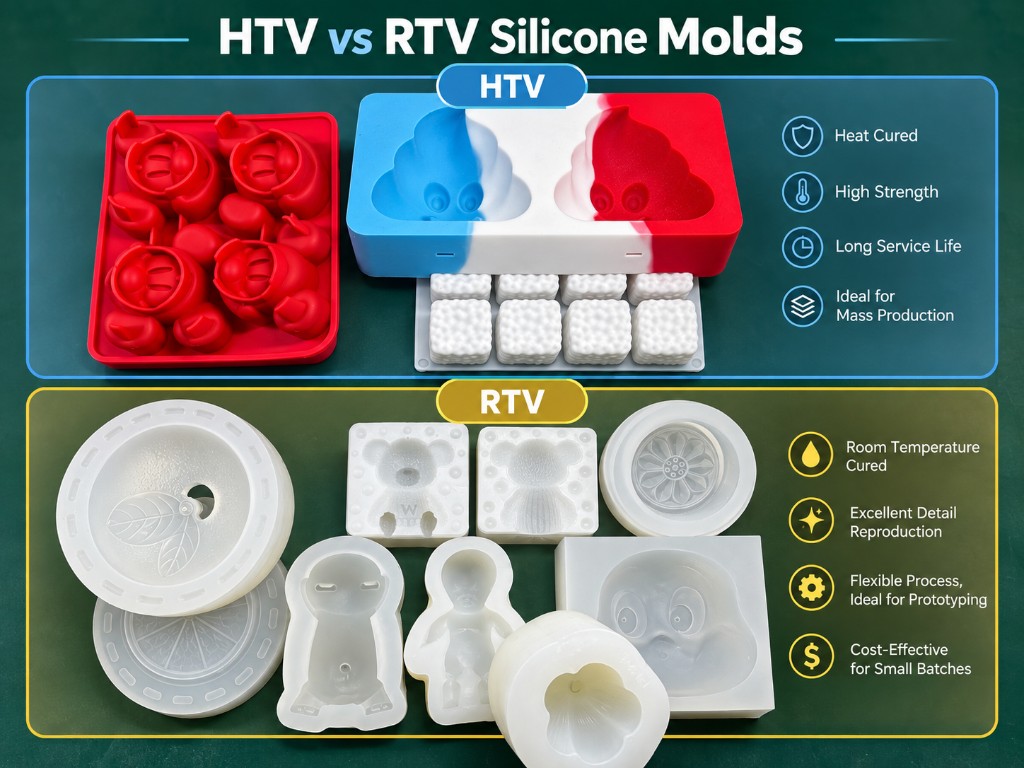
How an RTV Silicone Mold Is Made
Depending on geometry, the mold may be:
Typical route: 3D/CAD → Resin Master Model → Mold Planning → RTV Silicone → Room-Temperature Cure → Final Casting Mold.
RTV is especially effective where the mold needs to flex around a complex casting during demolding.
- one-piece open
- slit
- two-part
- multi-part
- core-supported
- supported by a rigid mother mold
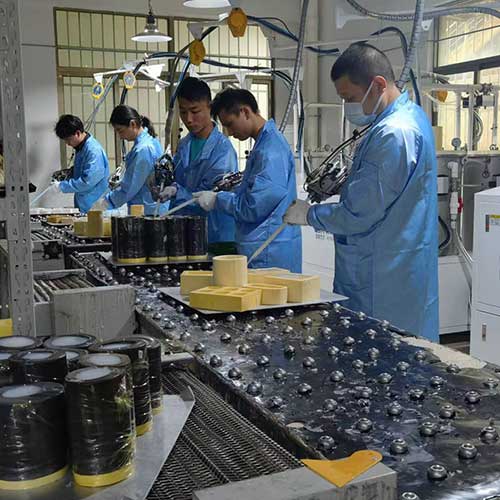
How an HCR/HTV Compression-Molded Silicone Mold Is Made
Typical route: CAD → DFM → Metal Tooling → HCR/HTV Material Preparation → Heated Compression Molding → Trimming → Inspection.
This process is well suited to repeat manufacturing once the geometry and cavity layout are stable.
When RTV Is Usually the Better Starting Point
Consider RTV when:
- the casting is a complex 3D figurine
- deep undercuts require flexible peel-off demolding
- the customer wants a plaster/resin/candle mold
- initial quantity is small
- design may still change
- producing a resin master is more practical than machining production tooling
- the mold requires a large flexible skin plus support shell
Examples: religious figurine, sculpture, resin ornament, plaster statue, complex candle, detailed soap, prototype casting mold.
When HCR/HTV Compression Molding Is Usually the Better Route
Consider compression-molded silicone molds when:
- the product is a repeat-use tray
- cavity layout is stable
- many identical trays are required
- dimensional repeatability is important
- the design is compatible with production tooling
- long-term repeat orders justify the tooling investment
Examples: gummy trays, chocolate molds, ice molds, baking molds, popsicle molds, food-production trays, branded multi-cavity silicone trays.
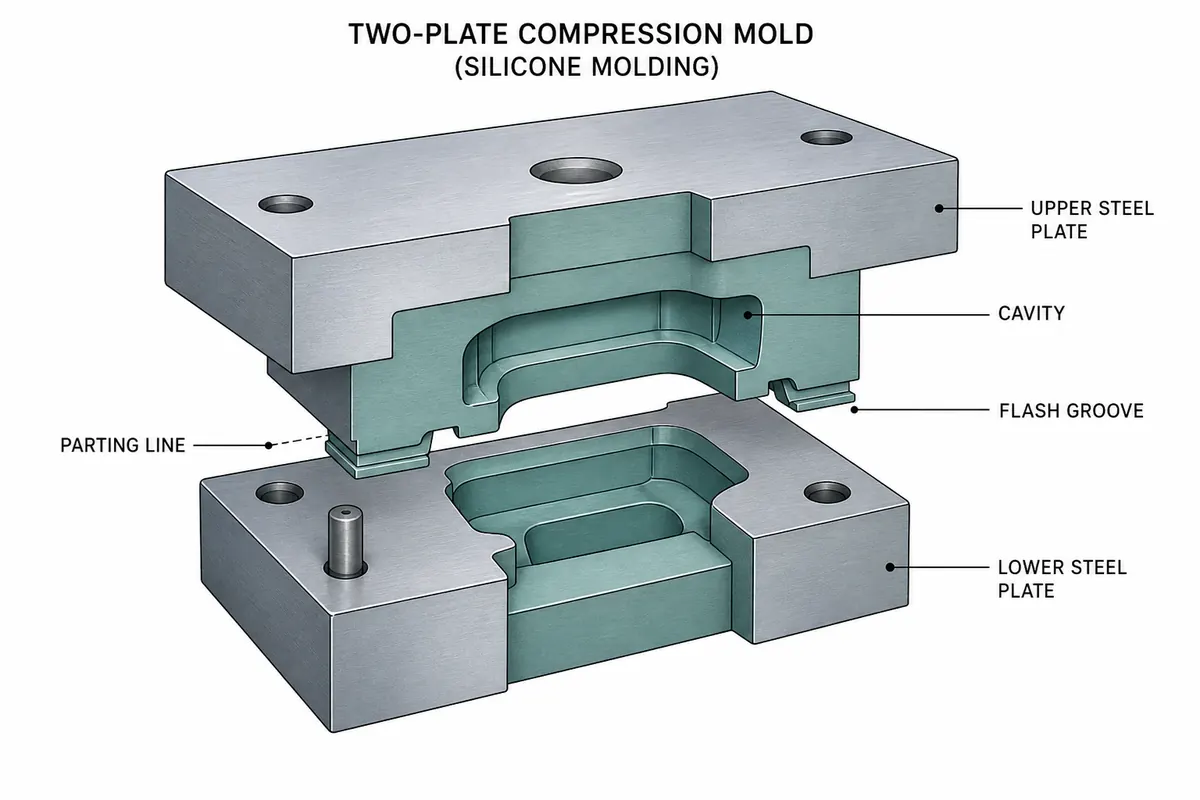
Complex 3D Does Not Automatically Mean Steel Is Better
A key mistake is assuming that a more expensive metal tool is automatically the “professional” option.
For a full 3D sculpture with large undercuts, RTV may be the more professional manufacturing choice because the silicone can peel during release, split lines can be planned around the sculpture, a rigid mother mold can carry the load, and the resin master can reproduce complex artistic geometry efficiently.
A compression mold is not the default solution for every complex shape.
Production Volume Matters, but It Is Not the Only Factor
Also review:
A larger repeat order often strengthens the case for metal production tooling.
But volume alone is not enough.
- geometry
- mold size
- cavity count
- casting material
- demolding method
- service temperature
- required surface
- customer handling process

Cost Structure
RTV cost may include:
3D/CAD, resin master, mold box, split planning, RTV silicone, rigid support shell, manual finishing and test casting.
HCR/HTV cost may include:
DFM, metal tooling, CNC machining, trial molding, HCR/HTV silicone, trimming, QC and repeat unit production.
Do not compare only the first mold price. Compare the total production requirement.
Mold Life
Do not publish a universal cycle count for either process. Life depends on:
- silicone grade
- geometry
- undercuts
- demolding force
- casting material
- heat/chemical exposure
- cleaning
- storage
- frequency
- operator handling
For repeat commercial production, validate the actual mold and process.
Food-Contact Applications
Both RTV and HCR/HTV silicone systems can potentially be selected for food-contact applications, but suitability is material- and use-specific. Confirm:
- selected silicone compound
- food type
- temperature
- contact duration
- destination market
- required reports
Do not state that all RTV or all HTV silicone is automatically food-contact compliant.
Which One Should You Choose?
Choose RTV first when:
You need flexible casting geometry, complex 3D, undercuts, lower initial quantity or a master-based mold process.
Choose HCR/HTV compression first when:
You need repeat production of stable silicone trays/molds using metal tooling.
Still not sure?
Send the 3D file or images, overall size, casting/application material and expected quantity. We can compare the two manufacturing routes before you commit to tooling.
What to send for a process review
- 3D file or images
- overall size
- casting/application material
- expected quantity
Request an RTV vs HCR/HTV Process Review
WYD offers both routes. Send the geometry and quantity so we can compare RTV and HCR/HTV before you commit to tooling.